If your garage floor has dropped near the door, cracked across the middle, or started holding water every time it rains, you are not alone. We see this all over Central Texas, from Austin to Round Rock and Cedar Park. A sunken garage slab is usually a sign that the soil under the concrete has shifted, dried out, washed away, or simply lost the support it had when the house was built.
In many cases, sunken garage floor repair in Texas does not mean tearing the whole slab out. With modern foam injection, a contractor can often lift and stabilize the concrete in place. That means less downtime, less mess, and a much lower price than full replacement. If the slab is still structurally sound, leveling is often the smart move.
At Hill Country Slabs, we help homeowners figure out whether a garage floor can be lifted, whether it needs crack and joint work, or whether replacement is the better call. The key is understanding why it sank in the first place.
What Causes a Garage Floor to Sink in Texas?
Texas soil is tough on concrete. Around the Hill Country and I-35 corridor, we deal with highly expansive clay that swells when it gets wet and shrinks when it dries out. That constant movement puts stress on slabs, especially at garage doors, driveway transitions, and perimeter edges. In areas with rocky fill or mixed subgrade, the slab may settle unevenly as the base compacts over time.
Here are the most common reasons a garage floor sinks in Texas:
- Expansive clay soil movement: Clay-rich soils in Central Texas can change volume dramatically between wet and dry seasons.
- Poor compaction during construction: If the fill material under the slab was not compacted well, it can settle later under vehicle weight.
- Water intrusion and erosion: Broken drainage patterns, roof runoff, or poor grading can wash out soil beneath the slab edge.
- Drought conditions: Long dry spells pull moisture from the soil, causing shrinkage and loss of support.
- Plumbing leaks: In some garages, hidden water lines or adjacent leaks can soften or erode the subgrade.
Garage floors are especially vulnerable because they often sit next to the driveway and garage apron where runoff collects. Once water starts moving under the slab, the supporting soil can disappear faster than most homeowners realize. That is when you start seeing a lip at the garage door, diagonal cracking, or one side of the floor sitting lower than the other.
If you are already dealing with separation at the control joints or perimeter joints, it is worth looking at expansion joint repair too. Open joints let in more water, which only speeds up settlement. For long-term joint protection, we also recommend quality sealing materials like those discussed at sealmyjoints.com.
How Foam Leveling Repairs a Sunken Garage Floor
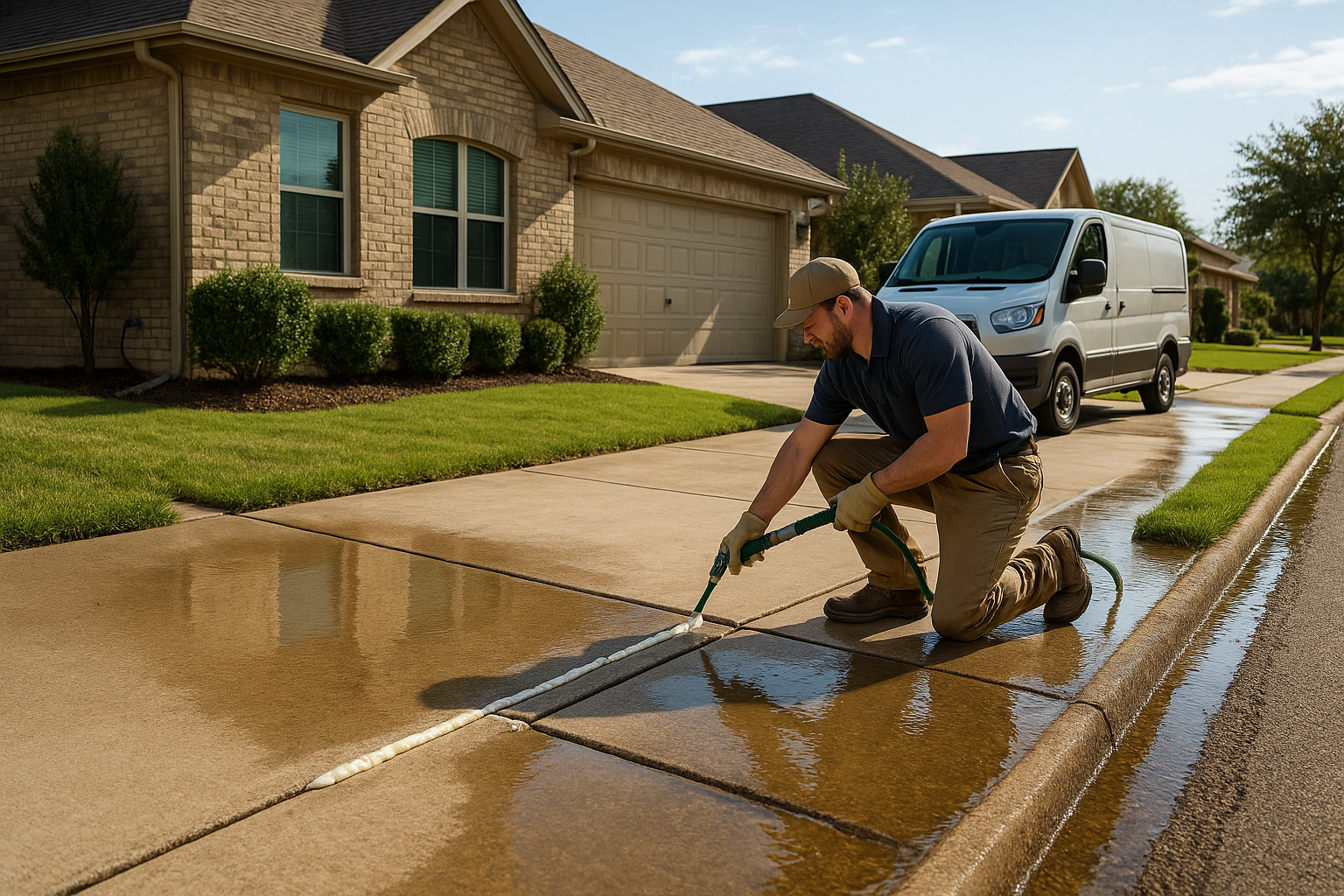
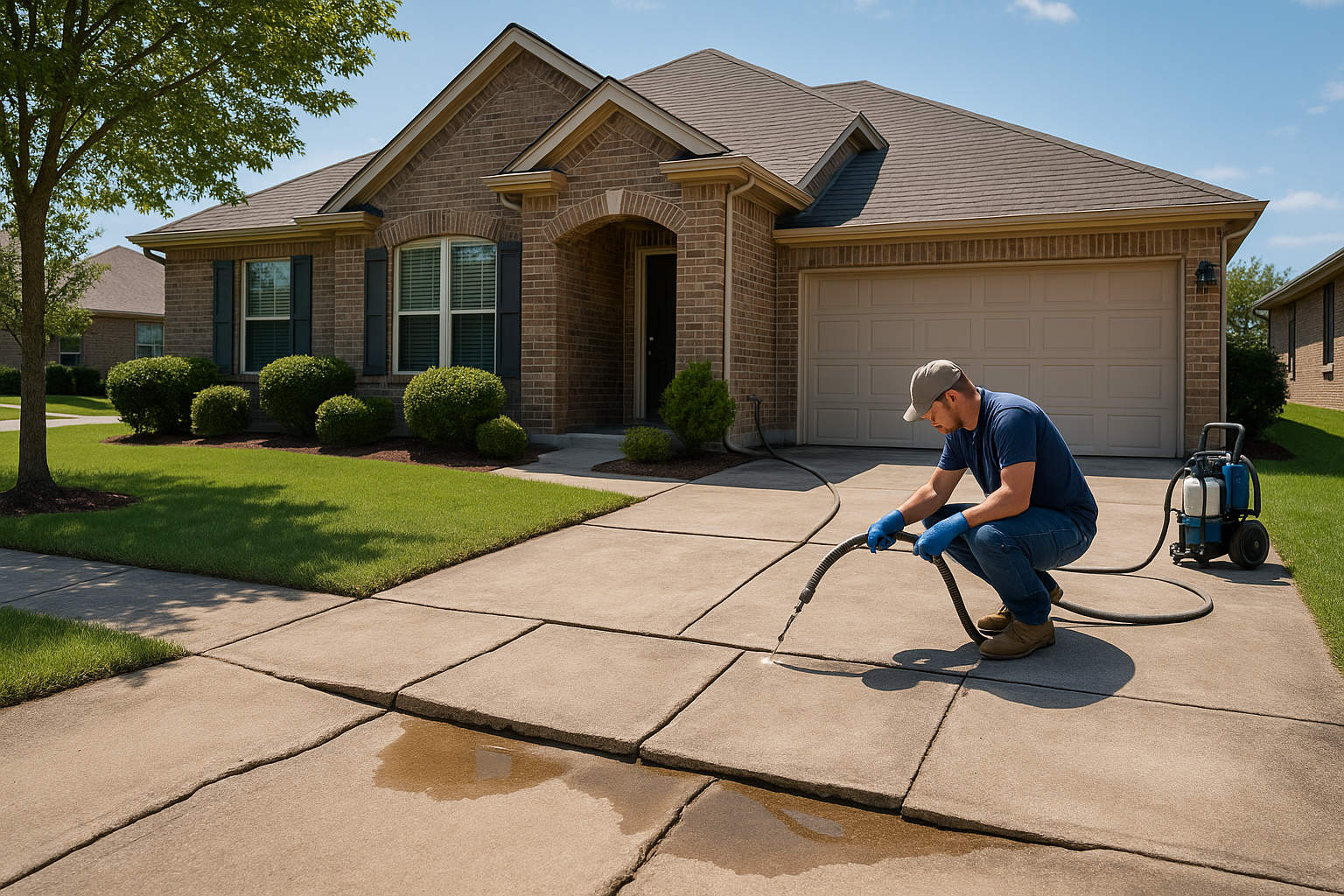
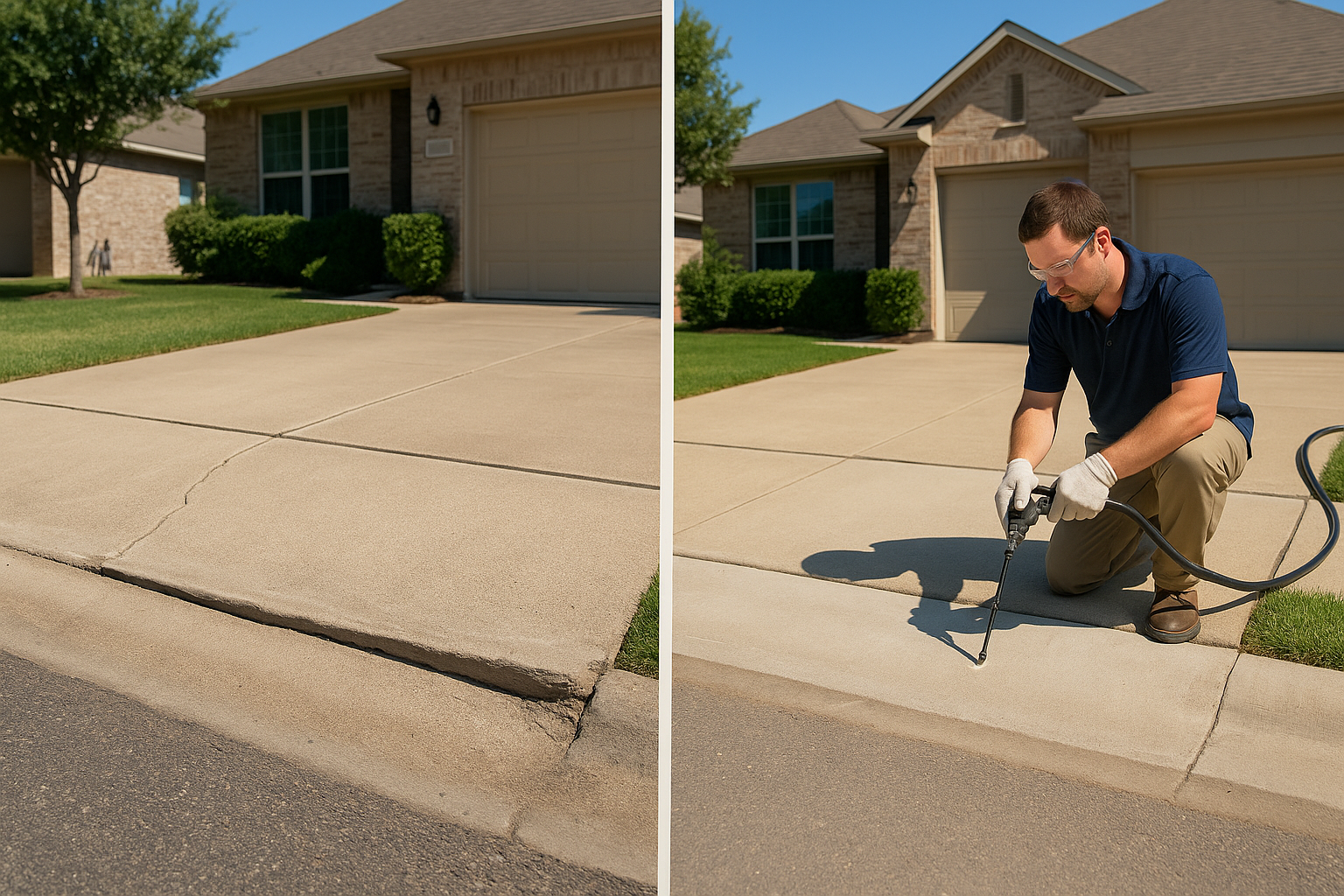
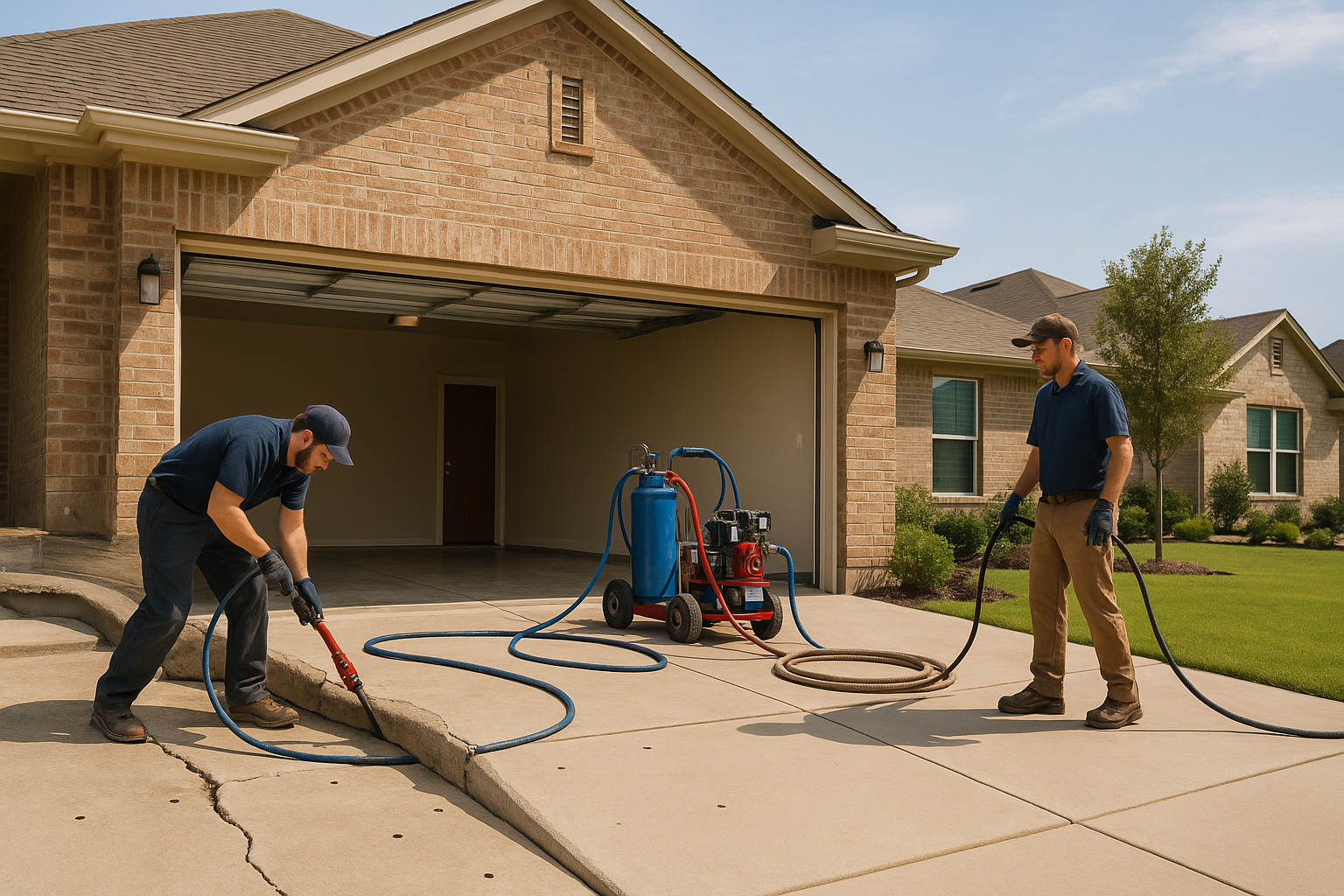
For many settled slabs, Garage Floor Leveling with polyurethane foam is the cleanest repair option. Instead of demolishing the concrete, we drill small holes through the slab and inject a two-part structural foam beneath it. The foam expands, fills voids, and applies controlled lift to bring the slab back toward grade.
Done correctly, foam leveling is fast and precise. In a lot of garage floor projects, the repair can be completed in a few hours, and the slab is ready for use the same day. That matters when you do not want your vehicles, tools, or storage displaced for a week.
The basic process looks like this:
- Inspect the slab for settlement pattern, cracking, drainage problems, and voids.
- Measure elevation loss and identify where support is missing.
- Drill small injection holes in targeted areas.
- Inject structural polyurethane foam under the slab.
- Lift and stabilize the concrete in controlled increments.
- Patch the holes and review any joint or crack sealing needed.
The biggest advantage is that foam does not add much weight to already unstable soil. Traditional mudjacking uses a heavier slurry, which can work in some situations but is not always ideal on weak Texas subgrades. Polyurethane foam is lightweight, water-resistant, and effective for filling voids under garage slabs, driveways, walkways, and other residential concrete.
Homeowners are often surprised at the cost difference. Full replacement can easily run $8,000 to $15,000+ once demolition, haul-off, rebar, forming, and repouring are included. Foam lifting for a garage floor is often in the range of $1,500 to $4,500, depending on slab size, depth of settlement, access, and whether there is major cracking. Every job is different, but if the concrete is still in decent shape, lifting is usually the better value.
If the garage settlement is tied into broader slab movement around the home, a more complete Concrete Slab Repair plan may be needed. That is why a real inspection matters. You want to know whether you are fixing an isolated garage issue or a larger foundation-related problem.
When to Repair vs Replace a Garage Floor
Not every garage slab should be lifted. Some can be saved, and some are too far gone. The right answer depends on the condition of the concrete, the amount of settlement, and what caused it.
Repair is usually the better option when:
- The slab is mostly intact with minor to moderate cracking.
- The floor has settled but has not shattered into multiple loose sections.
- There are voids under the concrete that can be filled and stabilized.
- The garage door opening and adjacent driveway can still be matched reasonably well.
- You want a faster, less invasive fix with lower cost.
Replacement may be necessary when:
- The slab is severely broken, heaved, or crumbling.
- The concrete has widespread structural failure or bad surface deterioration.
- The original pour was too thin or poorly reinforced.
- Drainage or subgrade conditions require major reconstruction.
- Previous repairs have failed because the underlying issue was never corrected.
One thing we tell Texas homeowners all the time: do not wait too long. A small drop of 1 to 2 inches at the garage entrance can turn into bigger cracking, trip hazards, poor door seal, and water intrusion into the garage. Once moisture keeps getting under the slab, the repair usually gets more expensive.
You also want to look at what is happening around the garage. Is the driveway pulling away? Are the joints open? Is runoff from the roof dumping near the slab edge? Are there signs of settlement elsewhere on the property? Addressing the slab without fixing the water path is only half a repair.
In places like Austin and surrounding areas, we often see seasonal movement where the slab drops during a dry summer and the symptoms get worse after a heavy rain event. That cycle is hard on concrete. Keeping joints sealed, controlling drainage, and lifting the slab before the crack pattern worsens can add years to the life of the floor.
Get a Free Sunken Garage Floor Inspection
If your garage floor is sloping, cracked, or sinking near the door, do not assume replacement is your only option. Many Texas garage slabs can be lifted and stabilized without tearing everything out. The best first step is a site inspection to see how much settlement has occurred, what the soil and drainage are doing, and whether foam leveling is a good fit.
At Hill Country Slabs, we provide practical recommendations based on what the slab is actually doing in the field. If it can be lifted, we will tell you. If it needs more than leveling, we will tell you that too. Either way, you get a straight answer from a contractor who understands Texas soil, weather swings, and local slab behavior.
We serve homeowners across Austin, Round Rock, Cedar Park, and nearby communities. If you have questions about a settled garage slab, water intrusion, open joints, or trip hazards, contact our team for a free inspection.
Ready to fix your sunken garage floor? Schedule an inspection today at /contact or call (737) 287-4308. We will help you figure out whether your garage floor can be repaired, lifted, and protected before the damage gets worse.