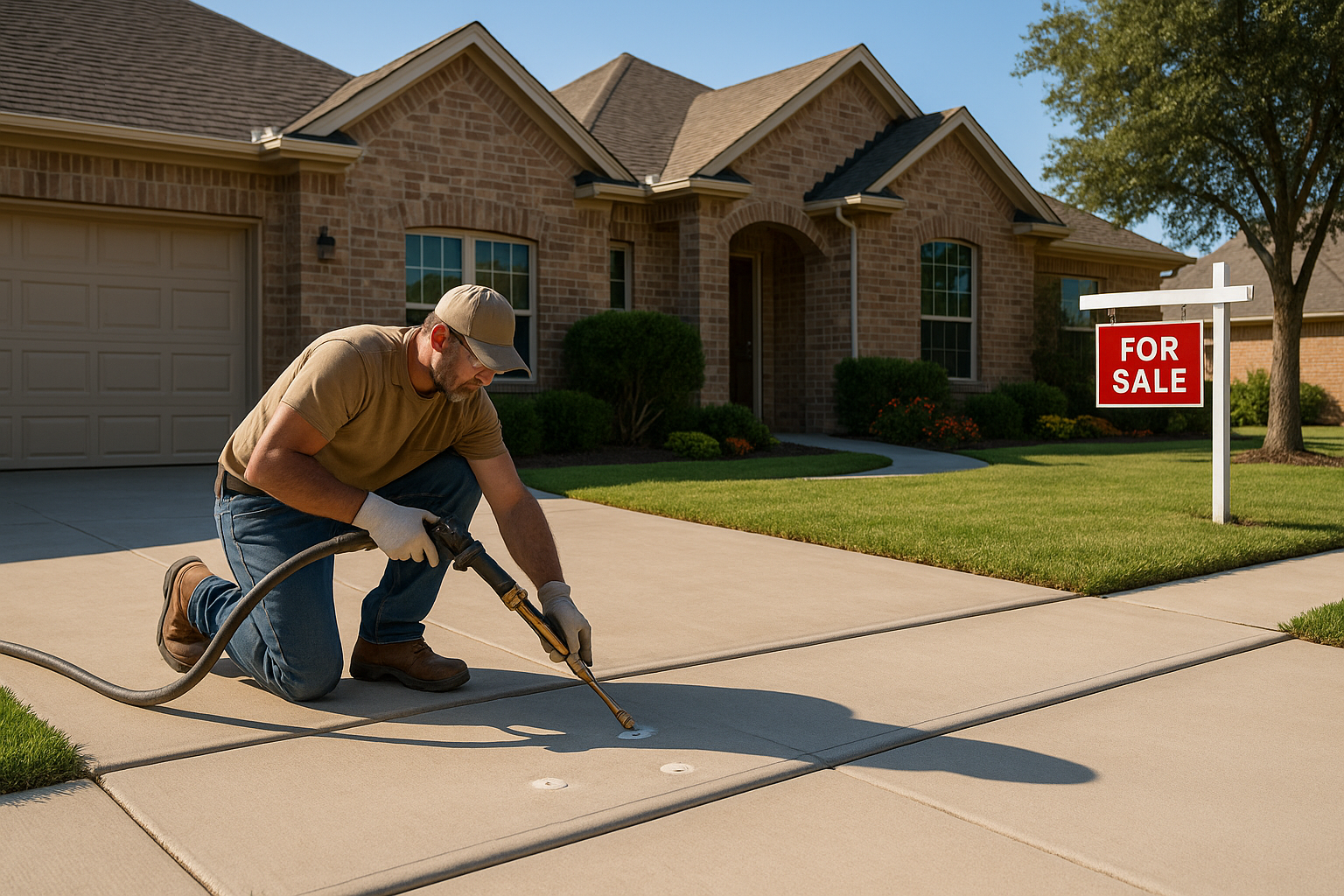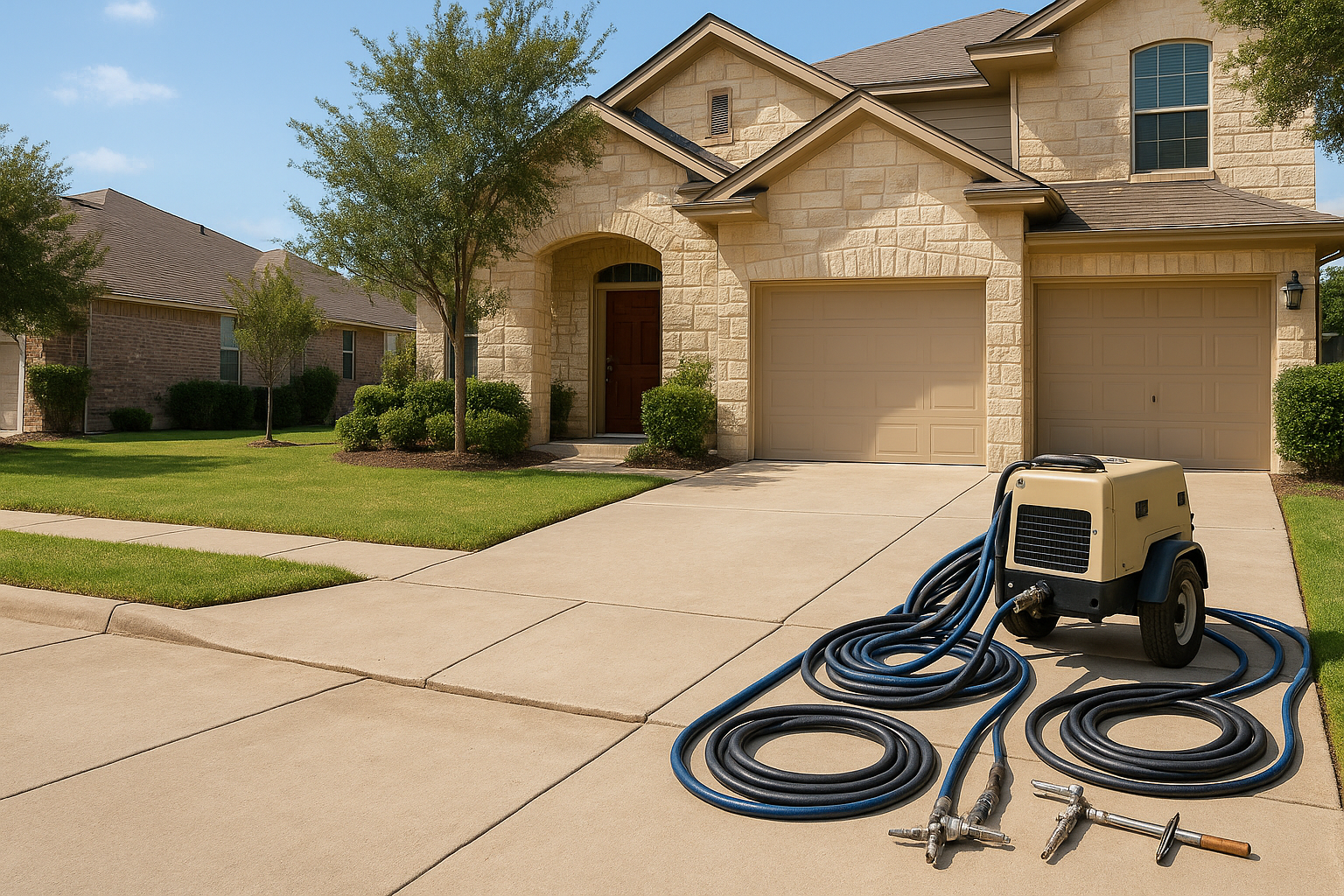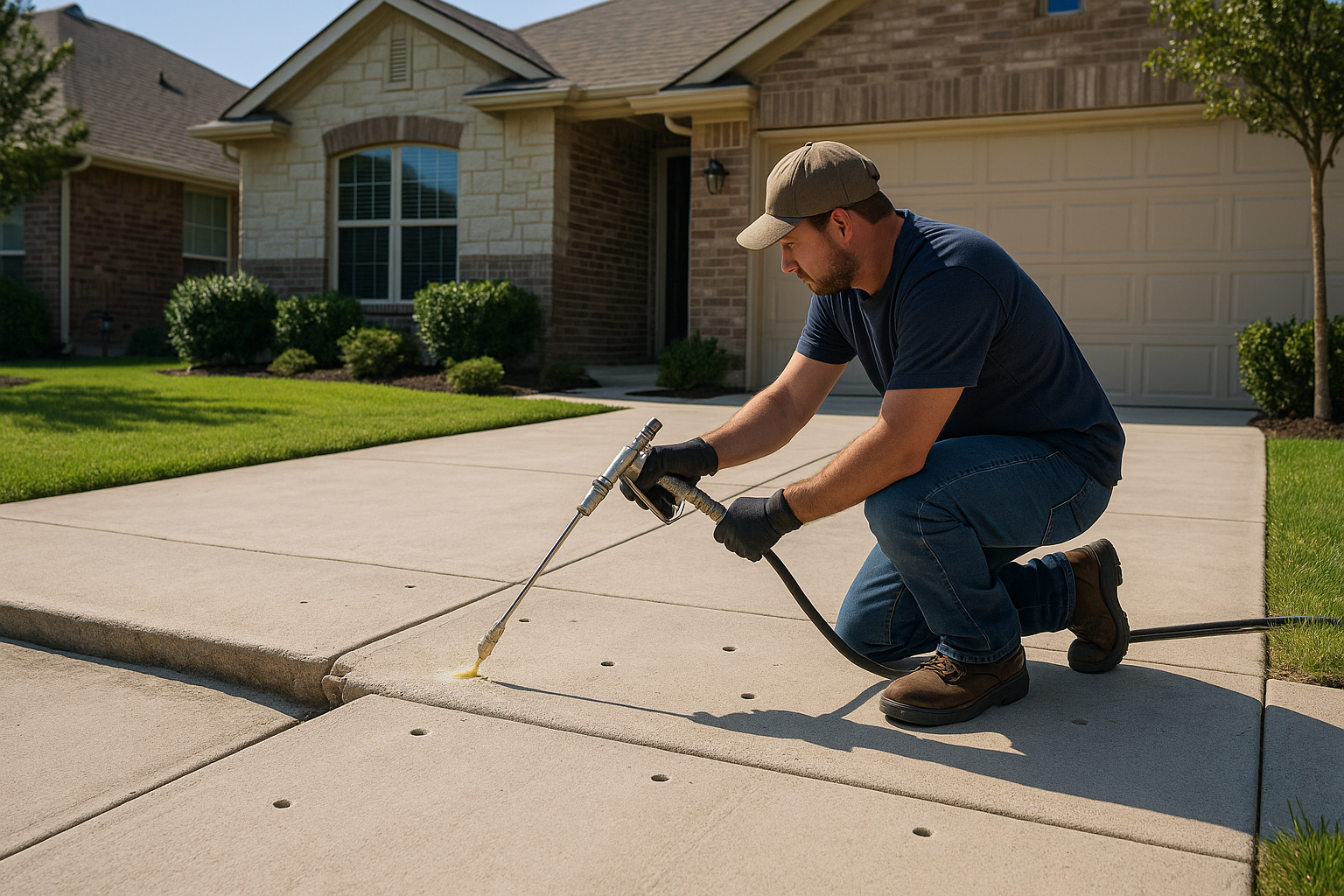
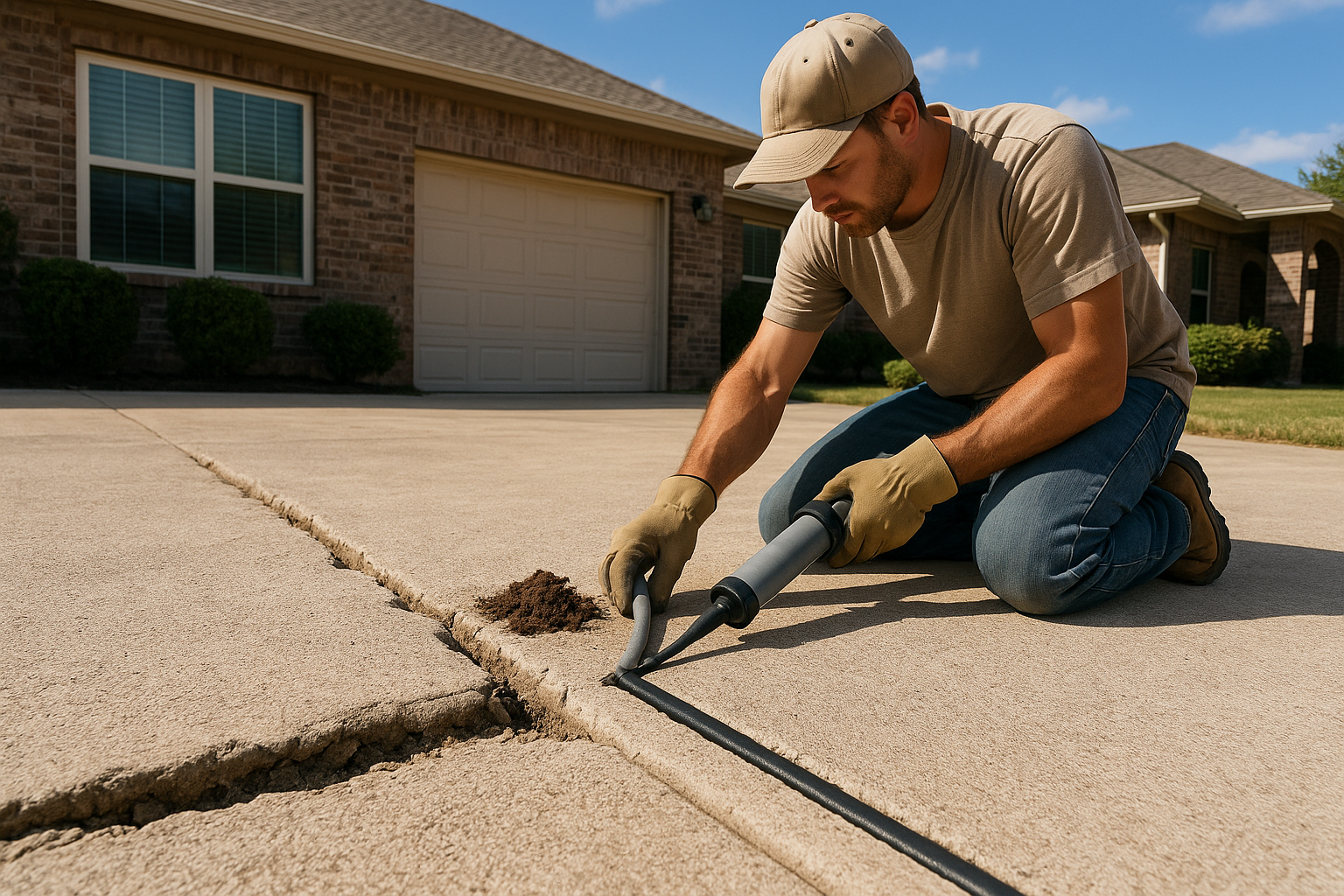
In Texas, expansion joints take a beating. Between long stretches of summer heat, sudden downpours, clay-heavy soils, and hard dry spells, the material in your concrete joints does not last forever. Once those joints fail, water starts working its way below the slab. That is when you begin seeing cracking, edge spalling, soil washout, and sections of concrete that start settling lower than the slab next to them.
If you are dealing with a driveway, patio, sidewalk, or pool deck, expansion joint replacement in Texas is one of the most affordable ways to protect your concrete before you end up paying for slab lifting or replacement. In a lot of cases, a failed joint that could have been repaired for a few hundred dollars turns into thousands in concrete repair costs once water gets underneath the slab and starts eroding support.
At Hill Country Slabs, we see this all over Austin, Round Rock, Georgetown, and across Central Texas. The combination of expansive clay soils, limestone-based subgrades in some areas, and intense weather swings makes joint maintenance a bigger deal here than a lot of property owners realize.
What Expansion Joint Replacement Fixes
An expansion joint is there to give concrete room to move. Slabs expand in the heat, contract in cooler weather, and shift slightly with seasonal soil movement. The joint material sits between slabs or where concrete meets the house, garage, or another fixed structure. Its job is simple: keep water out while still allowing movement.
When that material dries out, cracks, shrinks, or pulls away from the concrete edges, it stops doing its job. That leads to a chain reaction of problems:
- Water intrusion below the slab
- Soil erosion and washout under driveways and walkways
- Cracking along slab edges
- Sinking or separated concrete sections
- Trip hazards where one panel drops lower than another
- Foundation-adjacent moisture issues where joints meet the home
In Texas, this matters even more because a lot of our residential areas sit on highly reactive clay soil. When the soil gets wet, it swells. When it dries out, it shrinks and pulls away. That constant movement can open voids fast once water starts entering through failed joints. If you already have settlement, pairing joint repair with Void Filling Under Concrete in Texas is often the right next step.
For homeowners trying to protect a driveway specifically, Driveway Expansion Joint Replacement Texas is one of the smartest maintenance services you can schedule before visible sinking starts.
Signs Your Concrete Joints Need Replacement
Most failed joints are easy to spot once you know what to look for. The problem is that people get used to seeing them and assume it is cosmetic. In reality, the joint is your first line of defense against water getting where it should not.
Common warning signs
- Joint material is cracked, brittle, or missing
- The sealant has pulled away from one or both sides of the concrete
- There are open gaps where you can see dirt, weeds, or standing water
- One slab edge is starting to chip or flake
- You notice ant mounds or insect activity coming through the joint
- Water sits in the joint after rain instead of shedding off
- One section of concrete is lower than the next
In Central Texas neighborhoods, we see this a lot after a summer of drought followed by fall or spring storms. The joint dries out, separates, and then heavy rainfall pushes water straight into the gap. Over time, that repeated cycle undermines the slab.
There is also a big difference between a sealed joint and one that just has old filler stuffed into it. Proper replacement usually includes removing the failed material, cleaning the joint thoroughly, installing the right backer rod depth, and sealing it with a flexible product designed for concrete movement. If you want to understand more about the importance of this process, visit /expansionjoints.
Why Failed Joints Lead to Cracks and Sinking
A lot of people think concrete cracks only because of age. Age is part of it, but around Texas, water and soil movement are usually the bigger story.
Here is what happens. Once a joint opens up, rainwater runs down through the gap and into the base material below the slab. If the base was not compacted perfectly to begin with, or if the surrounding soil is expansive clay, that moisture starts changing conditions underneath the concrete. Fine soils wash away. Small voids form. The slab loses uniform support. Then the edges begin carrying more load than they were meant to, and cracking starts.
On a driveway, this gets worse fast because vehicles add repeated weight right near the joint. On sidewalks and patios, the result is often differential settlement where one slab drops and the next one stays put. Either way, a joint failure can turn into a structural concrete issue.
Texas weather makes this worse in a few ways:
- Extreme heat causes expansion and faster breakdown of old joint materials
- Sudden heavy rains can force a large volume of water below the slab in a short time
- Drought conditions shrink clay soils and leave gaps that are easy to erode later
- Freeze events, while less frequent, can still widen existing failures in North and Central Texas
In places like Austin and Georgetown, we also deal with mixed soil and rock conditions that can create uneven support. In Round Rock and surrounding areas, movement can be unpredictable from lot to lot depending on fill, drainage, and clay content. That is why you cannot judge a failed joint by appearance alone. A joint that looks minor on top can already be allowing serious washout below.
As a general rule, replacing failed joints early is far cheaper than correcting settlement later. Joint replacement is preventative maintenance. Slab lifting, void filling, and panel replacement are corrective repairs. There is a big difference in cost between the two.
How Expansion Joint Replacement Works
A proper expansion joint replacement is not just smearing new sealant over an old gap. Done right, the process is clean, deliberate, and built around getting long-term adhesion and flexibility.
- Inspection and measurement
We inspect the joint width, depth, surrounding slab condition, and any signs of settlement, cracking, or erosion. If the concrete has already started dropping, joint replacement alone may not be enough. - Removal of failed material
Old fiberboard, cracked sealant, debris, weeds, and loose material are fully removed. The joint has to be clean before anything new goes in. - Joint cleaning and prep
Dust and residue are cleaned out so the sealant can bond properly to the concrete sides. Skipping prep is one of the biggest reasons cheap joint jobs fail early. - Backer rod installation
A properly sized backer rod is installed to control sealant depth and create the right shape. This helps the sealant stretch and compress as the slabs move. - Application of flexible sealant
A high-quality joint sealant is applied to seal out water while allowing movement. For many exterior concrete joints, a professional-grade polyurethane or silicone product is the right choice depending on the application. - Final finish and cure
The joint is tooled for a clean finish and allowed to cure based on product requirements and weather conditions.
If you are comparing options, good workmanship matters as much as the material. A sloppy install with the wrong depth or poor adhesion will not hold up through a Texas summer. For product-specific information and additional guidance on sealing materials, homeowners also look at resources like sealmyjoints.com.
When joint replacement should be paired with other repairs
There are times when replacing the joint is only part of the solution. If water has already washed out the base and the slab is unsupported, sealing the gap without addressing the void can trap the problem in place. In those cases, we may recommend void stabilization first, then resealing once support is restored.
You should have the slab looked at if you notice:
- A corner or edge has dropped more than 1/4 to 1/2 inch
- Cracks are spreading outward from the joint
- The slab sounds hollow when tapped
- Water disappears quickly into the joint during rain
- The joint runs directly toward the garage, foundation, or entry walk where drainage matters
For many Texas properties, the best repair plan is to stop water entry first, correct any developing washout, and then maintain the joint going forward. That is especially true around driveways and sidewalks where runoff concentrates hard during storms.
Why Texas Homeowners Should Not Wait
Expansion joint failure is one of those problems that looks small until it is not. By the time a slab is visibly sinking, the water has usually been getting underneath for a while. In our part of Texas, that can happen faster than people expect because of the combination of intense rain events and moving soils.
If your joints are open, brittle, or separating, this is the right time to deal with them. Replacing a failed expansion joint is usually far less expensive than replacing cracked or settled concrete. It also helps preserve drainage, reduce trip hazards, and protect the life of the slab you already paid for.
If you are in Austin, Round Rock, Georgetown, or nearby Texas communities and need a straight answer on your concrete joints, Hill Country Slabs can help. We will tell you whether you just need resealing, whether washout is already happening, or whether the slab needs additional repair work.
Ready to get your concrete looked at? Contact Hill Country Slabs through /contact or call (737) 287-4308 to schedule expansion joint replacement in Texas.