In Texas, concrete does not usually fail because the slab itself is weak. Most of the time, it settles because the soil under it moves, dries out, washes away, or never got compacted right in the first place. We see it all over Central Texas in driveways, sidewalks, patios, pool decks, and warehouse floors. If you own property in Austin, Cedar Park, or Round Rock, chances are you have already seen a slab that dropped on one side, pulled away from the house, or started holding water where it used to drain clean.
The good news is settled concrete can often be repaired without tearing it out. With foam leveling, we can lift and stabilize many slabs fast, with small injection holes and very little disruption. In a lot of cases, that means you avoid the cost and mess of replacement while fixing the trip hazard and stopping the movement from getting worse. For many Texas property owners, repair costs come in at far less than full replacement, and the work is often completed in just a few hours.
If you are dealing with a sinking slab, this guide walks through what causes concrete settling in Texas, what warning signs to look for, how foam leveling works, and when it makes sense to repair now instead of waiting until replacement is the only option. If you need slab-specific help, take a look at our Concrete Slab Repair service.
What Causes Concrete Settling in Texas?
Texas soil is the big reason. Around Central Texas, we deal with expansive clay, rocky pockets, fill soil around new construction, and areas where runoff moves water exactly where you do not want it. Clay-heavy soils are especially rough on flatwork. They swell when they get wet, then shrink hard during hot dry stretches. That constant movement leaves voids under concrete, and once a slab loses support, it starts to settle.
In places like Austin and Round Rock, we also see elevation changes, fast drainage during storms, and erosion along the edges of driveways and sidewalks. One heavy rain can wash fines out from under a slab. Then during a dry spell, the unsupported section drops. In newer neighborhoods in Cedar Park and surrounding areas, poor compaction of fill soil can show up a few years after construction. The slab may look fine at first, then one season of rain and drought exposes the weak base underneath.
Common causes of concrete settling in Texas include:
- Expansive clay soils that shrink and swell with moisture changes
- Soil erosion from stormwater runoff, gutter discharge, or poor drainage
- Poor compaction under driveways, patios, and sidewalks during original construction
- Plumbing leaks or irrigation overspray that soften and move supporting soils
- Tree roots changing soil moisture conditions around slabs
- Edge washout where water gets under concrete and carries soil away
Another issue we run into a lot is missing or failed joint maintenance. When joints are left open, water gets down along the slab edges and starts working on the base material. That is why expansion joint care matters. If your slabs have open joints or deteriorated filler, it is worth looking at expansion joints and proper sealing. You can also find more joint sealing information at sealmyjoints.com.
Signs Your Concrete Is Settling
Most settled concrete does not happen overnight. Usually there are warning signs before the drop becomes severe. The earlier you catch it, the better chance you have of lifting the slab instead of replacing it.
Here are the signs we tell property owners to watch for:
- One slab edge sits lower than the one next to it
- Trip hazards on sidewalks, walkways, and driveway panels
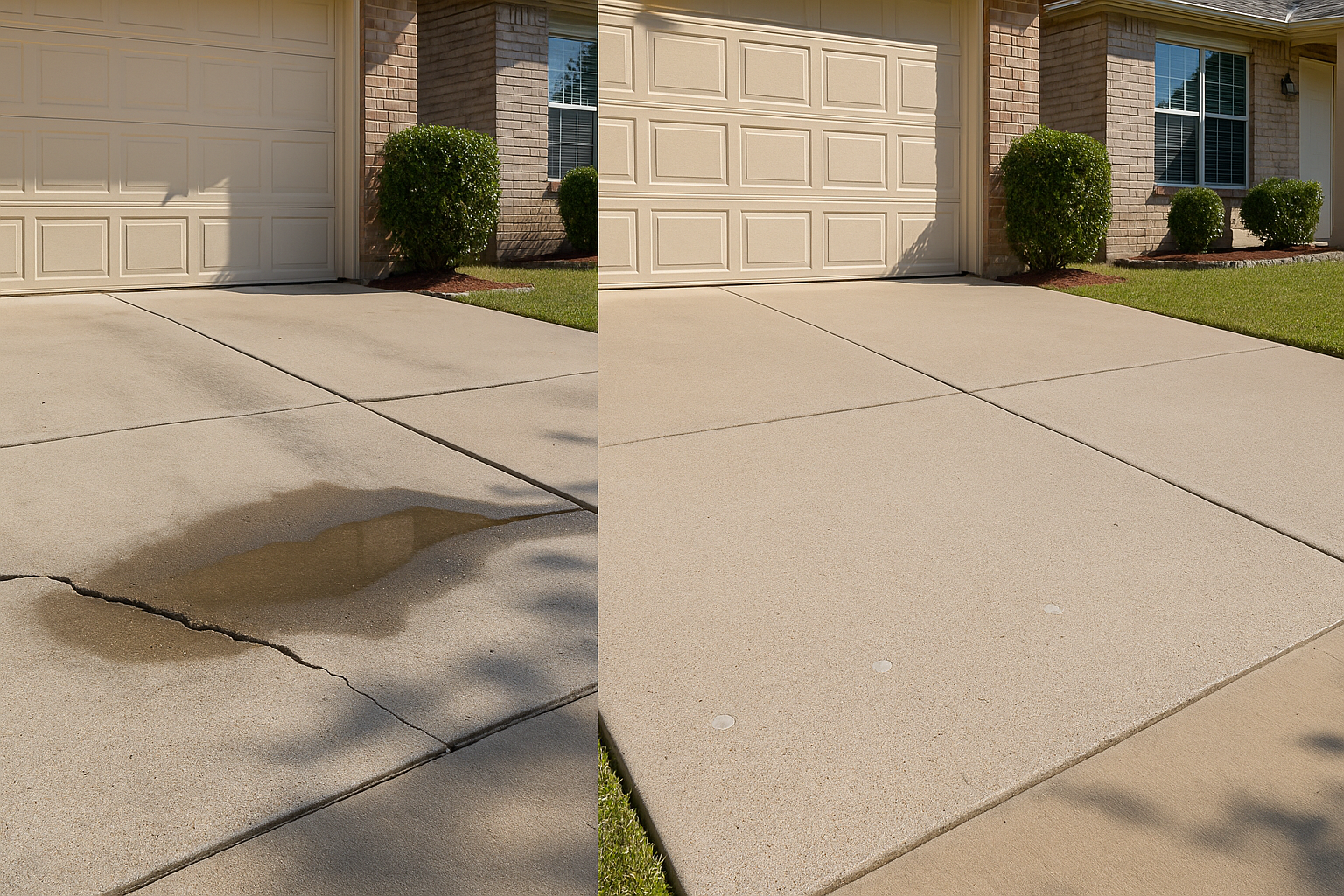
- Water ponding where the surface used to drain properly
- Gaps under the slab near edges or corners
- Cracks that widen as support underneath disappears
- Patios or pool decks pulling away from the house or coping
- Garage or driveway approach settlement near the street or apron
A simple example is a driveway panel that drops 1 to 2 inches at the garage or sidewalk connection. That may not sound like much, but it is enough to create drainage problems, stress the adjoining concrete, and turn into a real liability issue. On commercial properties, even a small differential can create safety concerns for foot traffic, carts, and ADA transitions.
We also tell customers not to ignore minor corner settlement. A slab corner that is only slightly down today can keep moving as water continues to get under it. What starts as a small liftable repair can turn into a broken slab if it is left alone too long.
How Foam Leveling Repairs Settled Concrete
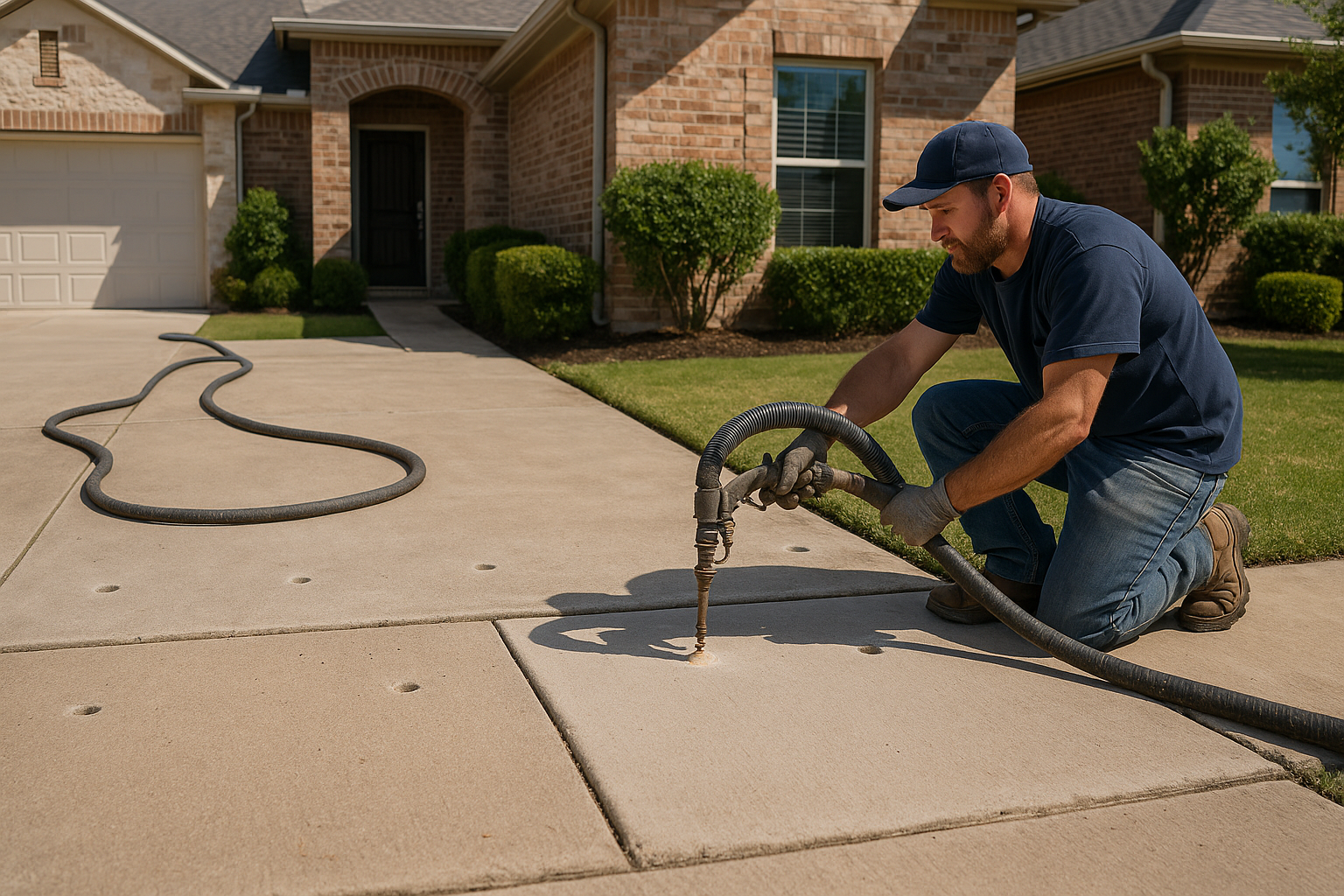
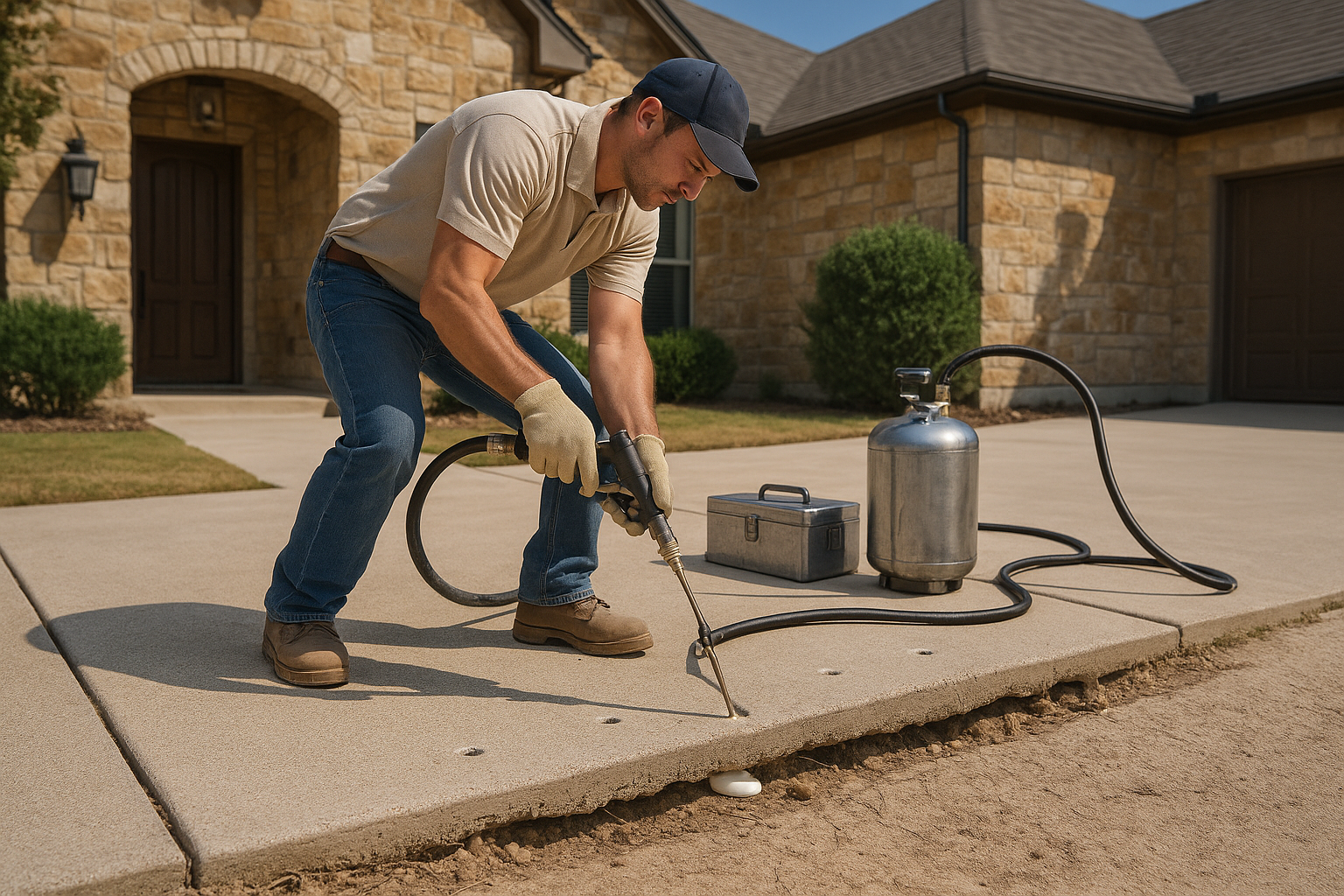
Foam leveling is one of the cleanest and most effective ways to repair settled concrete in Texas. The process uses small drilled holes in the slab to inject expanding polyurethane foam underneath. As the foam expands, it fills voids, lifts the slab, and helps stabilize the base. It is fast, controlled, and much less invasive than demolition and repour.
On most jobs, the process looks like this:
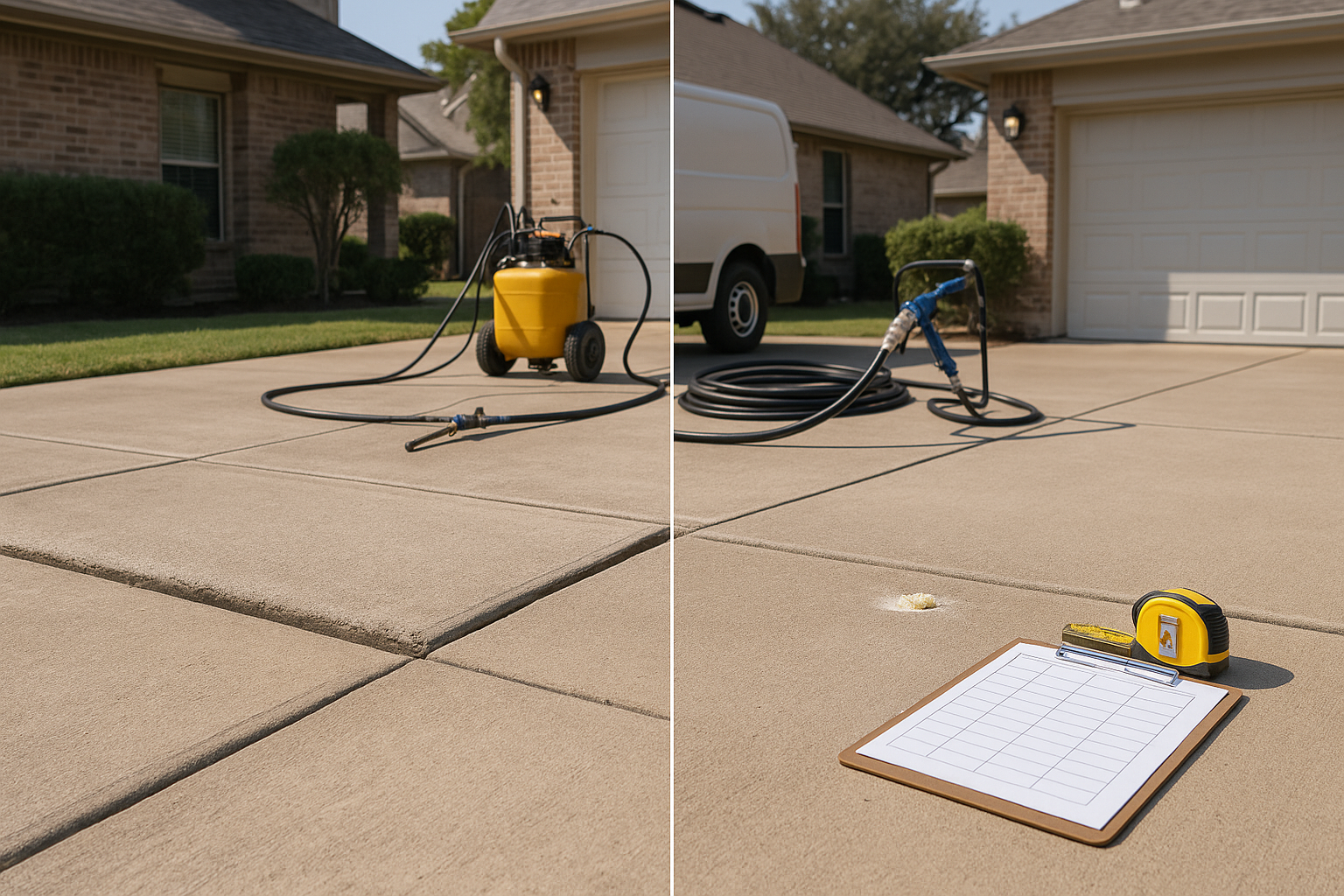
- We inspect the slab, measure the settlement, and identify likely causes like washout or poor drainage.
- We drill small injection holes in targeted locations.
- We inject polyurethane foam below the slab.
- The foam expands to fill empty space and gently lift the concrete.
- We fine-tune the lift for grade, then patch the holes.
The reason this works well in Texas is the foam is lightweight and does not add a heavy load back onto already unstable soils. Compared to older mudjacking methods, foam leveling gives better control and cures fast. In many cases, the slab is ready for use in about 15 minutes. That matters when you are repairing an active driveway, commercial walkway, or busy patio area.
Another advantage is cost. Full tear-out and replacement means demolition, haul-off, new base prep, forming, concrete placement, curing time, and sometimes matching issues with surrounding slabs. Foam leveling is often the better value when the concrete is still structurally decent. Depending on access, slab condition, and settlement severity, property owners often spend significantly less than replacement by lifting what they already have.
That said, lifting the slab is only part of the conversation. If drainage is bad, joints are open, or water is constantly hitting the same area, those problems should be addressed too. Otherwise, even a good lift can be put back under stress. We always look at the whole picture, not just the low corner.
When to Repair Settling Before Replacement
Not every slab needs to be replaced just because it settled. If the concrete surface is in decent shape and the main issue is loss of support underneath, repair usually makes more sense. We tell Texas customers to think about replacement when the slab is badly broken, shattered, heaved in multiple directions, or too deteriorated to hold together during lifting. But if it is mostly intact, foam leveling can often buy years of service and restore function fast.
Repair is usually the better option when:
- The slab has settlement but limited cracking
- The concrete is still structurally sound overall
- You want to remove a trip hazard without a full construction project
- You need a faster turnaround with minimal downtime
- You want to correct drainage caused by a sunken section
- You are trying to avoid the higher cost of replacement
Replacement usually enters the conversation when there is severe breakage, major subgrade failure across a large area, or previous repairs that no longer make sense. Even then, a site evaluation matters. We have seen plenty of slabs people assumed needed to be torn out that were good candidates for lifting and stabilization instead.
For Texas homeowners, the big reason to act early is simple. Settlement rarely improves on its own. The longer water keeps moving under the slab, the larger the voids tend to get. That means more movement, more stress on nearby concrete, and a bigger repair bill later. A small settled sidewalk in Austin or a slightly dropped driveway in Cedar Park is much easier to deal with now than after another summer drought and storm cycle.
If you are seeing sinking concrete around your home or commercial property, Hill Country Slabs can help you figure out whether it should be lifted, stabilized, or replaced. We work across Central Texas and understand the local soils, weather swings, and drainage issues that cause slabs to move in the first place.
Need help with concrete settling repair in Texas? Contact Hill Country Slabs for an honest evaluation and a practical fix. Visit /contact or call (737) 287-4308 today.