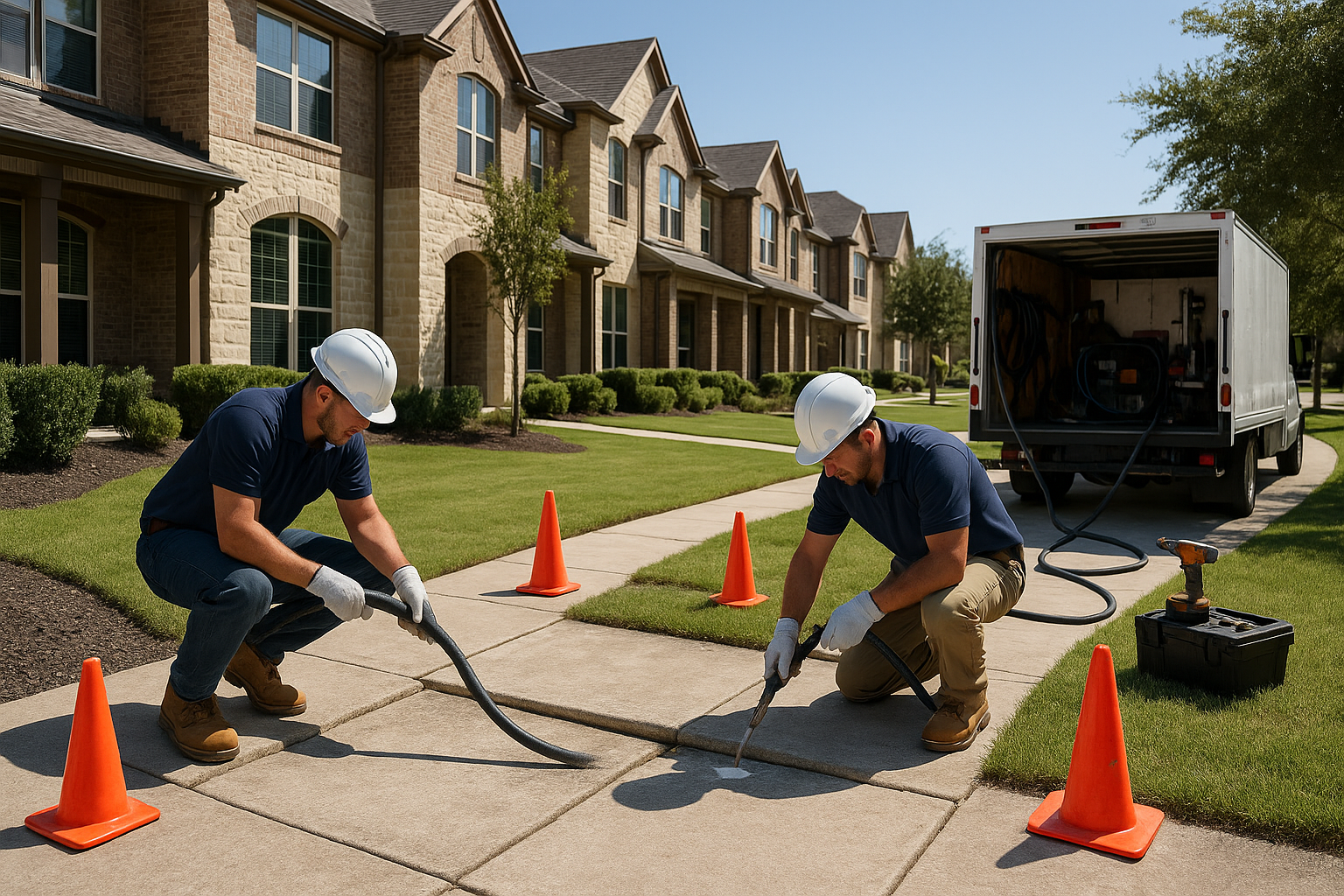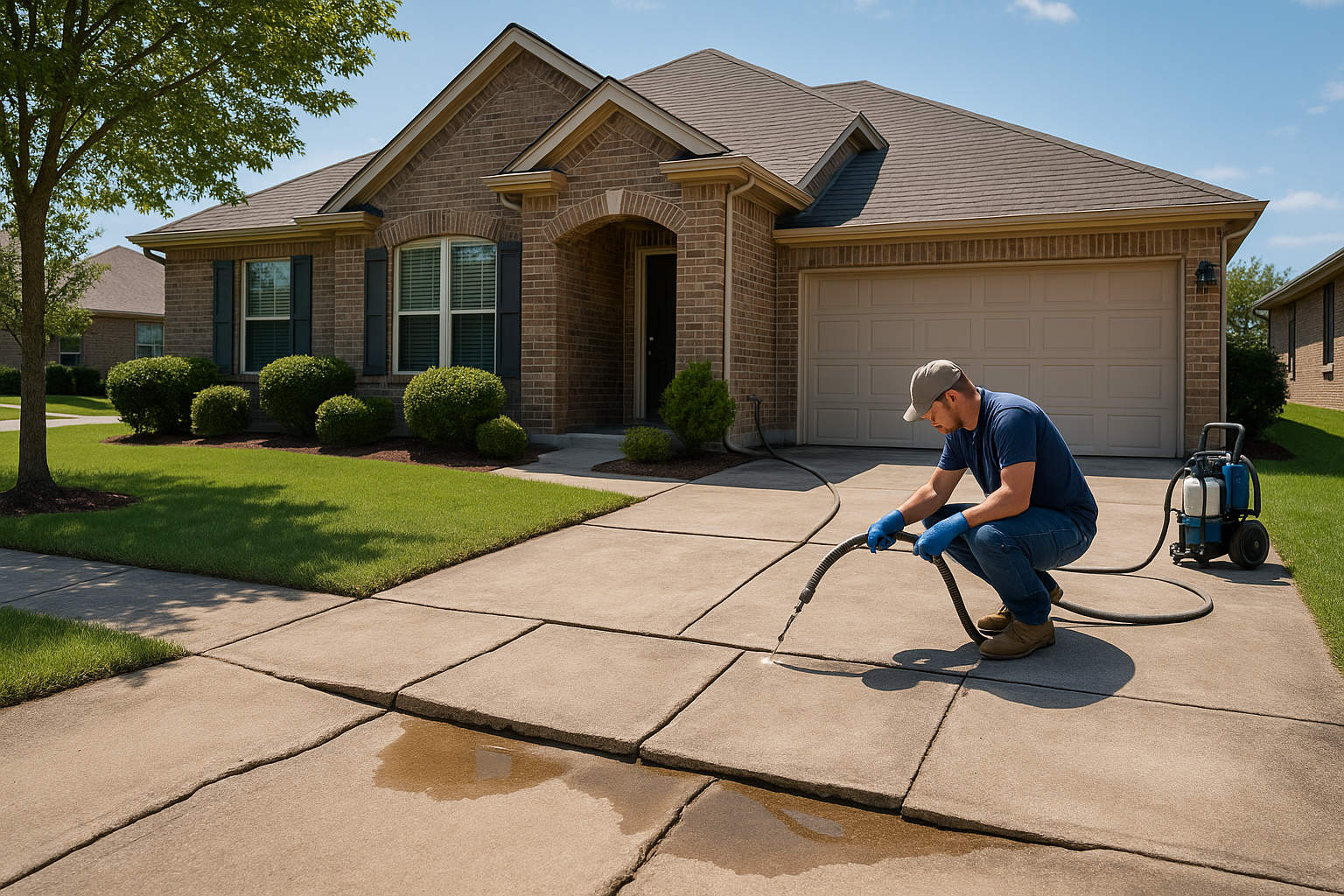
If you are dealing with uneven concrete at your home or business, concrete leveling in Liberty Hill, TX is usually the fastest and most cost-effective way to fix it. Around here, we see sinking driveways, settled sidewalks, patio slabs, and porch sections all the time. The good news is that a lot of these slabs can be lifted and stabilized without tearing everything out and starting over.
At Hill Country Slabs, we work on concrete across Central Texas, and Liberty Hill has the exact mix of conditions that causes slab movement: expanding clay soils, long dry stretches, heavy rains, and new development disturbing the ground. When a slab drops, it is not just an eyesore. It can create trip hazards, drainage problems, and extra stress on nearby concrete sections.
In many cases, leveling is a smarter fix than replacement. Foam lifting can often restore the slab in a matter of hours, with less mess and less disruption. Depending on access, slab condition, and how far it has settled, homeowners often find leveling costs far less than full replacement, especially when you factor in demolition, haul-off, and new concrete work. For many projects, repair can save 30% to 70% compared to replacement.
Why Concrete Sinks in Liberty Hill, TX
Liberty Hill sits in a part of Texas where soil movement is a real issue. A lot of the area has clay-heavy soils that expand when they take on moisture and shrink when they dry out. That constant cycle creates voids under concrete and leaves parts of a slab unsupported. Once traffic loads hit those weak spots, the concrete starts to settle.
We also see trouble from runoff and poor drainage. If rainwater washes under a driveway edge or along a sidewalk, it can erode the base material and leave empty pockets underneath. Then after one good storm, or one long drought followed by rain, the slab can shift. This is common not just in Liberty Hill, but in nearby Leander, Georgetown, and Austin too.
Here are some of the most common reasons slabs sink in Liberty Hill:
- Expansive clay soil shrinking during hot, dry weather
- Heavy rain events washing out support under the slab
- Poor compaction during original construction
- Plumbing leaks or irrigation issues softening the soil below
- Tree roots changing soil moisture around the slab
- Improper drainage pushing water toward the concrete instead of away from it
This is why we always look beyond the visible crack or drop. If the soil conditions and drainage are not addressed, the same problem can come back later. Expansion joint condition matters too. When joints fail, water gets down where it should not. If your joints are open or deteriorated, take a look at expansion joints and our joint sealing resource at sealmyjoints.com.
Signs You Need Concrete Leveling
Not every crack means a slab needs to be replaced. A lot of homeowners in Liberty Hill call us after they notice one corner of a driveway has dropped or a sidewalk panel has become a trip hazard. The earlier you catch settlement, the easier it usually is to correct.
Here are the main warning signs that concrete leveling may be the right repair:
- One slab section sits lower than the slab next to it
- Trip hazards at sidewalks, walkways, and entry paths
- Standing water on patios, driveways, or pool decks after rain
- Garage or driveway edges that no longer meet cleanly
- Porch or patio slabs pulling away from the house
- Cracks caused by settlement rather than surface shrinkage
- Bouncy or hollow-sounding concrete due to voids below
One of the biggest concerns is safety. A height difference of even 1/2 inch to 1 inch can be enough to catch a shoe, stroller wheel, or lawn equipment tire. That is especially true on sidewalks and front walkways. If the slab is still structurally sound, leveling is often the cleanest way to bring it back into position.
We handle this kind of work on more than just driveways. If your issue is a settled approach, take a look at Driveway Leveling. If it is a public-facing walkway or path around the house, our Sidewalk Repair service may be the better fit. For broader slab movement around a home or detached structure, see Concrete Slab Repair.
How Polyurethane Foam Leveling Works
Polyurethane foam leveling, also called foam lifting or slab jacking, is a repair method that raises settled concrete by filling empty space underneath and gently lifting the slab back toward grade. It is a good fit for many residential and light commercial slabs in Liberty Hill because it is precise, fast, and does not add much weight to already unstable soil.
- We inspect the slab to determine why it settled, how far it moved, and whether the concrete is a good candidate for lifting.
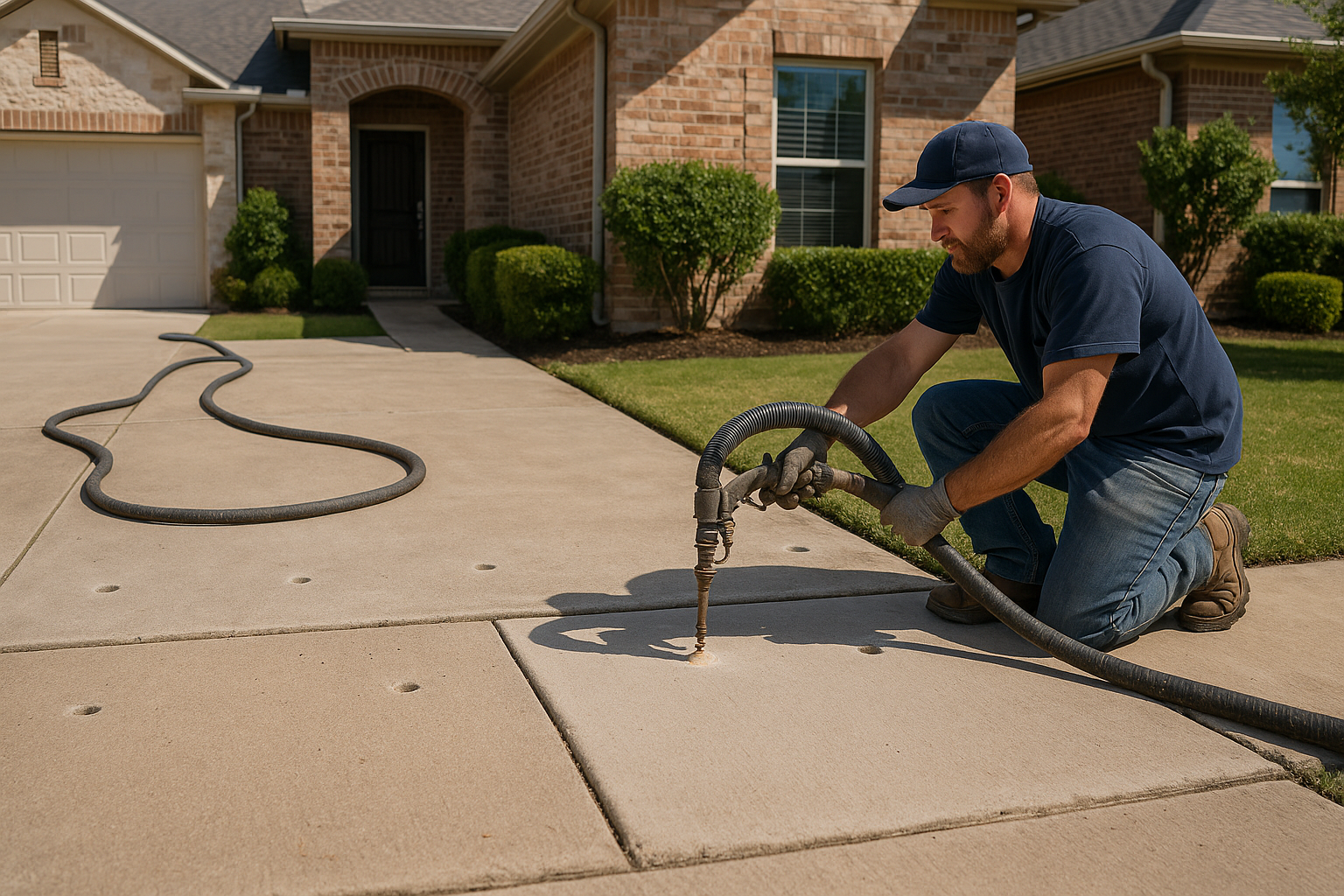
- Small injection holes are drilled through the slab in strategic locations.
- High-density polyurethane foam is injected beneath the concrete.
- The foam expands to fill voids, improve support, and lift the slab in controlled increments.
- The slab is rechecked for elevation and stability, and the drill holes are patched.
This process is a lot less invasive than replacement. There is no major tear-out, no waiting on a new pour, and no long cure time like you get with fresh concrete. In many cases, the slab can be used again the same day. For homeowners trying to keep a driveway, walkway, or patio in service, that matters.
Foam leveling also works well in Texas because the material is lightweight and water-resistant. It helps stabilize the slab without putting a heavy load on soils that are already moving. That said, it is not a miracle fix for every slab. If the concrete is badly broken, severely spalled, or has widespread structural failure, replacement may still be the right answer.
As a rough ballpark, homeowners often see leveling projects come in at a fraction of replacement cost. Smaller lifts may fall in the range of a few hundred to a couple thousand dollars, while full tear-out and replacement can jump much higher once labor, disposal, base prep, and finishing are included. Every job is different, but when the slab itself is still solid, foam lifting is often the better value.
Repair or Replace Your Concrete?
This is the question we hear every week: should you level the slab, or should you rip it out and pour new concrete? The answer depends on the condition of the slab, not just the fact that it has settled.
Repair makes sense when:
- The concrete is mostly intact
- The slab has settled because of voids or soil movement
- The cracks are limited and related to settlement
- You want a faster, less disruptive solution
- You want to avoid the higher cost of replacement
Replacement makes sense when:
- The slab is badly broken into multiple loose sections
- The surface has major deterioration or scaling
- The concrete was poured too thin or built wrong to begin with
- The slab cannot be lifted safely to a useful grade
- You are already planning a redesign or expansion
For a lot of Liberty Hill properties, repair is the practical move. Newer neighborhoods, rural homes on shifting ground, and driveways exposed to sun and runoff all deal with settlement. If the slab still has good overall integrity, leveling can extend its life and clean up the hazard without the cost and headache of starting over.
We also recommend looking at what caused the movement in the first place. Water management, grading, and joint maintenance all matter. If water keeps reaching the subgrade, the problem can return. Sealing joints and controlling runoff around the slab can protect your repair and help your concrete last longer in Central Texas conditions.
If you are noticing sinking concrete around your home in Liberty Hill, do not wait until the drop gets worse. Early repairs are usually simpler and more affordable, and they can help prevent further cracking and drainage problems. Whether it is a settled driveway panel, an uneven sidewalk, or a patio slab pulling out of level, our team can take a look and tell you honestly whether leveling or replacement makes the most sense.
Need concrete leveling in Liberty Hill, TX? Contact Hill Country Slabs for a straightforward evaluation and repair options that fit your property and budget. Visit /contact or call (737) 287-4308 today.