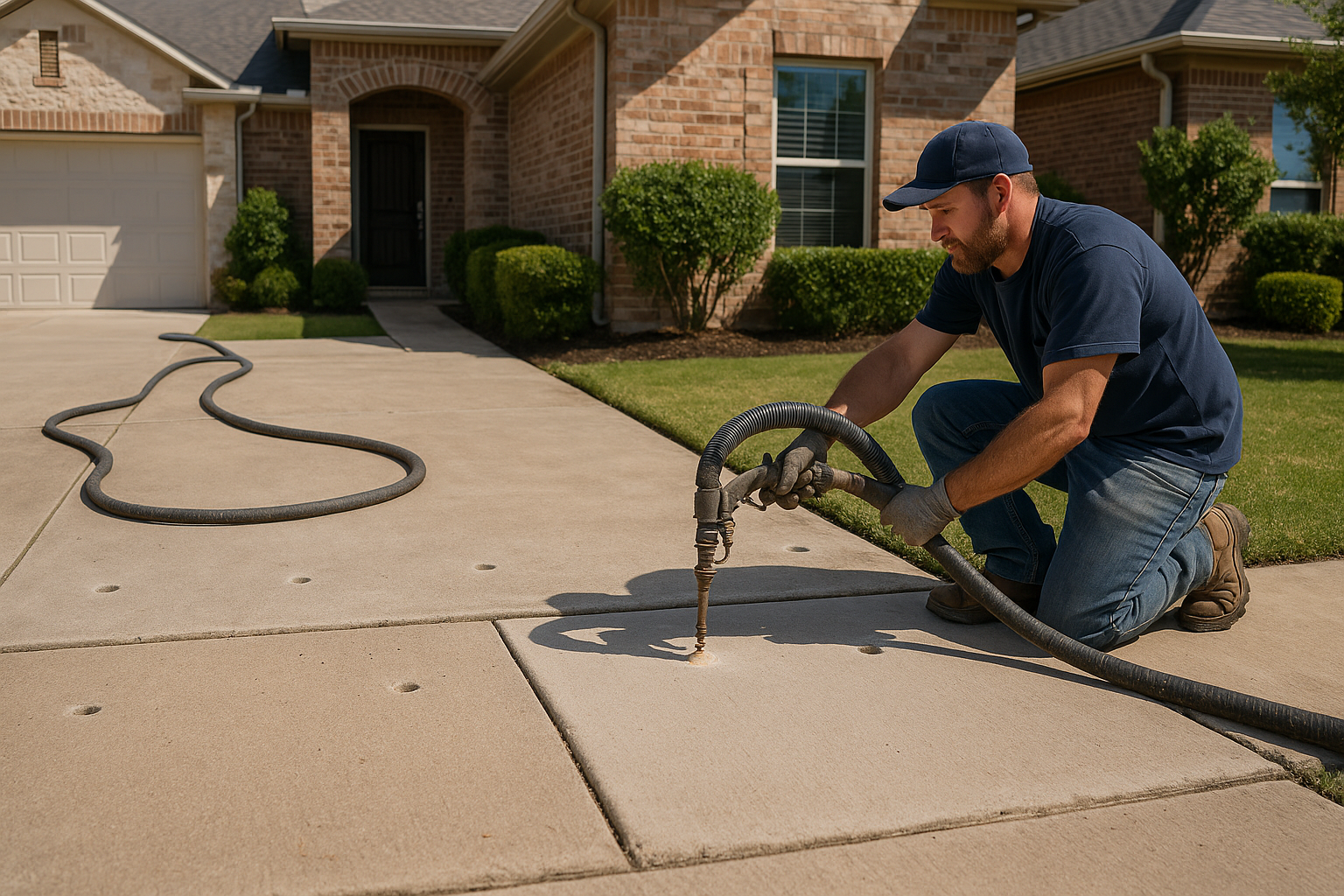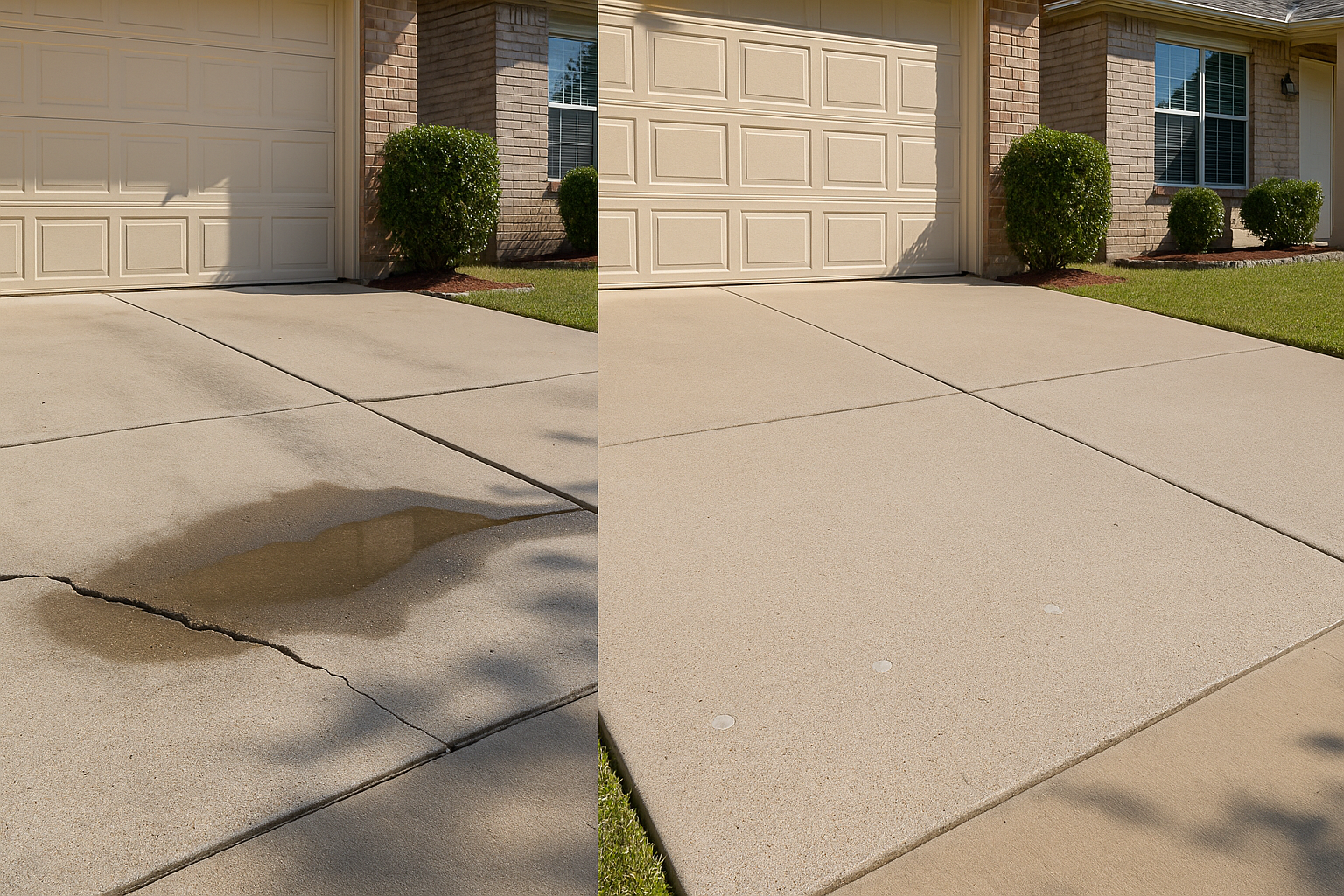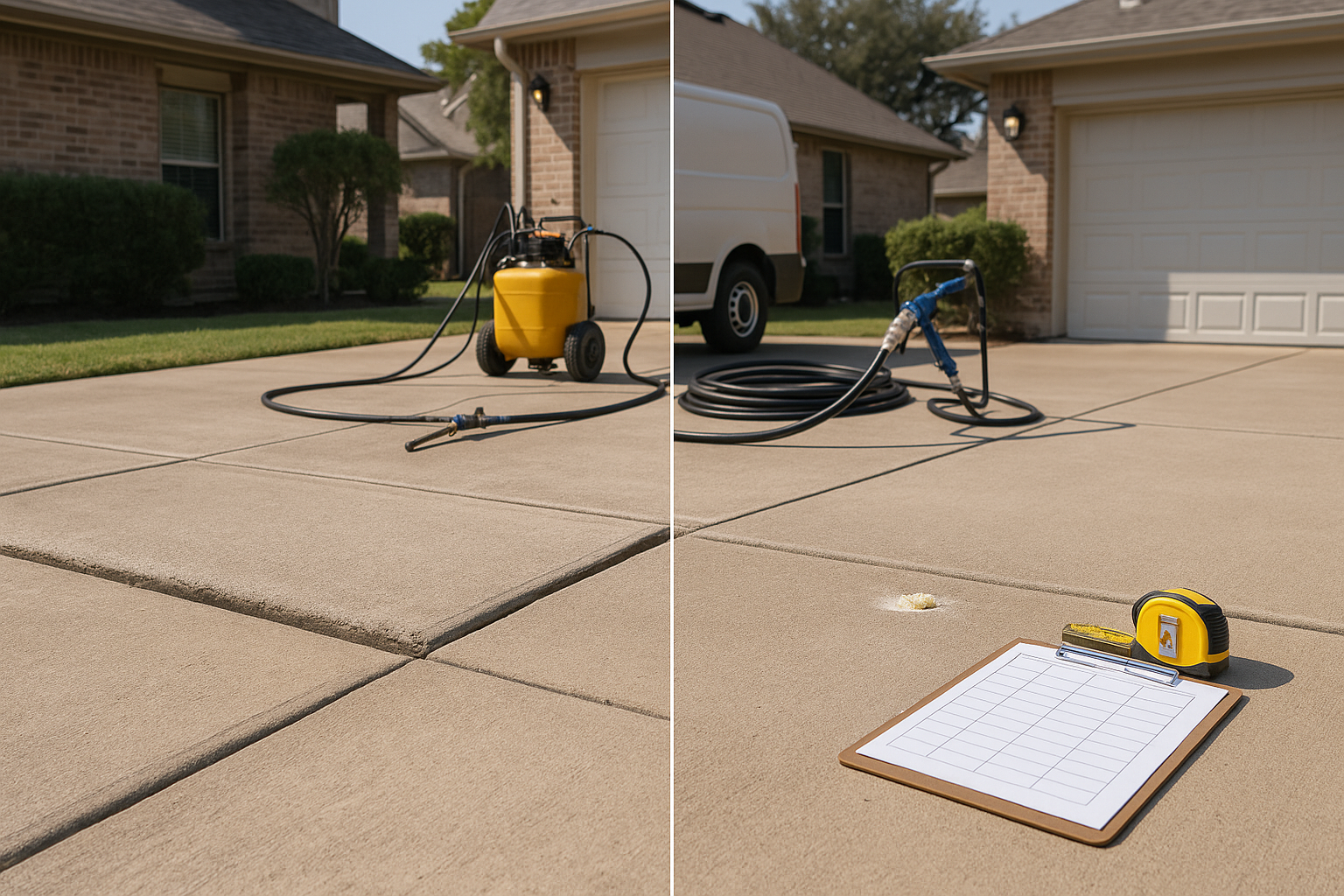
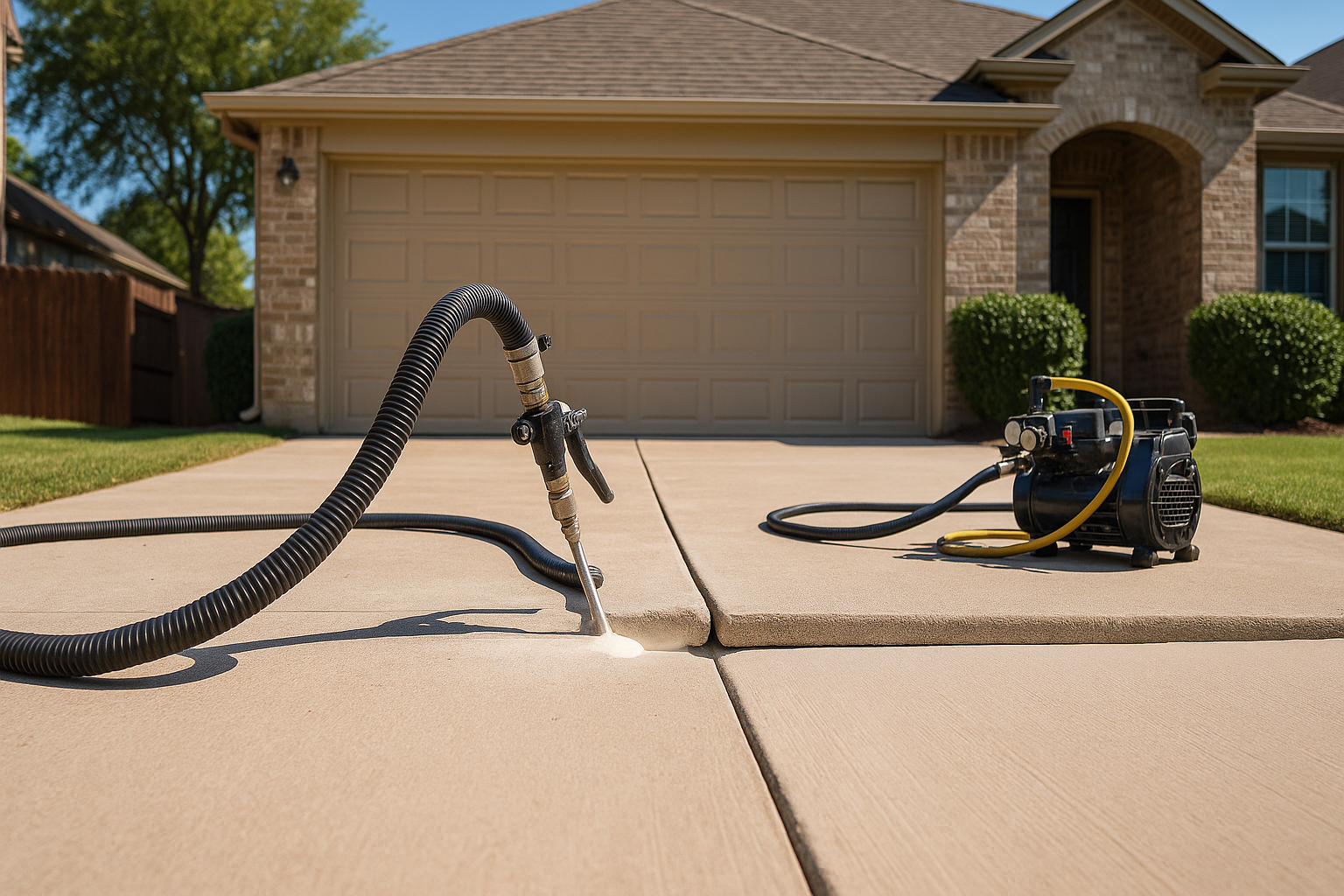
If you are pricing out a sunken driveway, the first question is usually simple: what is concrete driveway lifting cost in Texas? In most cases, homeowners here can expect to pay about $900 to $2,500 for driveway lifting, depending on how far the slab has dropped, how many sections are involved, and how much void space is sitting underneath the concrete. For smaller repairs, the cost may land closer to $600 to $1,200. For larger or more complicated driveways, it can run $2,500 to $4,000+.
That is still usually a lot cheaper than tearing out and replacing the whole driveway. Full replacement in Texas often runs $5,000 to $15,000+, especially if you are dealing with thicker concrete, longer driveways, demolition, haul-off, and new base prep. If the slab is still structurally sound, lifting it is often the better value.
At Hill Country Slabs, we see this all over Central Texas, from Austin to Round Rock. Expansive clay soils, dry summers, hard rains, and poor drainage all work together to wash out support or shrink the ground under a driveway. The slab drops, joints open up, and now you have a trip hazard and water running the wrong direction.
If you are comparing options, our Driveway Leveling service is built for exactly this kind of repair. When settlement extends beyond the driveway and starts affecting other flatwork or the house slab, it may also make sense to look at Concrete Slab Repair.
What Does Concrete Driveway Lifting Cost in Texas?
There is no perfect one-size-fits-all number, but here is a practical range for Texas homeowners.
- Minor lift on one or two panels: about $600 to $1,200
- Typical residential driveway leveling: about $900 to $2,500
- Larger settlement areas or deeper voids: about $2,500 to $4,000+
- Full driveway replacement: often $5,000 to $15,000+
Most of the time, lifting is priced by how much material it takes to fill voids and raise the slab, plus how difficult the setup is. A driveway with only a slight drop at one joint is very different from a long approach that has settled several inches near the garage or sidewalk connection.
In Texas, we also pay close attention to the subgrade. Blackland prairie clay around Austin, Round Rock, Temple, Waco, and Dallas-Fort Worth is notorious for movement. When that clay dries out, it shrinks. When heavy rain comes back, it swells. Over time, that cycle can leave unsupported areas under concrete. In parts of the Hill Country, rock and thin soils can create a different problem, where runoff erodes support at slab edges and low spots.
That is why a real estimate has to be based on site conditions, not just square footage. The same driveway size can have two very different repair costs depending on what is going on underneath.
What Affects the Cost of Lifting a Driveway?
1. How much the driveway has settled
A slab that has dropped half an inch is usually easier and less expensive to correct than one that is down two or three inches. More settlement generally means more foam, more injection points, and slower lifting to avoid overstressing the concrete.
2. Size of the repair area
If only one panel near the street or garage has settled, the repair cost stays lower. If multiple sections are out of level, the price goes up. We are not just lifting concrete; we are restoring support across the affected area.
3. Amount of void space underneath
This is a big one. Sometimes the concrete looks like it only dropped a little, but there is a large hollow area under it from soil shrinkage, poor compaction, or water erosion. The more voids we have to fill, the more material the job requires.
4. Access and layout
A straight, open driveway is easier to work than a tight layout with landscaping, walls, gates, or parked obstacles. Limited access can add labor time and slow the setup.
5. Soil and drainage conditions
Texas soil is rough on flatwork. Expansive clay is a major cause of driveway movement, but drainage is just as important. If downspouts dump at the slab edge, if the yard grades toward the driveway, or if water is pooling at joints, settlement can keep coming back. In a lot of cases, we recommend addressing drainage and joint sealing along with the lift.
That is where expansion joints matter. Open joints let water run below the slab, softening or eroding the support layer. After leveling, sealing those joints helps protect the repair. Homeowners can also learn more about joint protection at sealmyjoints.com.
6. Condition of the concrete itself
Lifting works best when the slab is basically still in good shape. Cracks are not always a deal breaker, but if the concrete is badly broken, crumbling, or heaved in multiple directions, replacement may be the smarter long-term move.
When Is Driveway Lifting Better Than Replacement?
As a contractor, this is the way I look at it: if the concrete is still usable and the main problem is settlement, lifting usually makes more sense than starting over.
Driveway lifting is often the better option when:
- The slabs are sunken but mostly intact
- The height difference is creating a trip hazard or drainage issue
- You want to avoid demolition and haul-off
- You need a faster repair with less mess
- You want to save money compared to replacement
Foam leveling is especially appealing because the repair is quick and the slab can often be used again much sooner than newly poured concrete. You are also keeping the existing driveway in place instead of paying for removal, forming, reinforcing, pouring, and curing.
Replacement is usually the better call when:
- The driveway is severely cracked or broken into many loose pieces
- The surface is scaling badly or the concrete is worn out
- The slab was poured too thin or built wrong from the start
- Tree roots, major drainage failure, or widespread base failure have caused extensive damage
For plenty of homeowners in Austin, Round Rock, Georgetown, Cedar Park, and the surrounding Hill Country, the answer falls somewhere in the middle. The driveway itself may be salvageable, but the real fix includes lifting, sealing joints, and improving drainage so the slab does not settle right back down.
That is why we do not like throwing out generic pricing without seeing the job. A driveway with stable concrete and one low section can be a very cost-effective repair. A driveway with active water intrusion and years of movement needs a broader plan.
Get a Free Quote for Driveway Lifting in Texas
If you are dealing with a sunken driveway, uneven panels, standing water, or a growing trip hazard, the best next step is to get it looked at before the movement gets worse. In many cases, concrete driveway lifting cost is a fraction of replacement, and catching it early usually keeps the repair simpler.
Hill Country Slabs handles driveway leveling and concrete settlement repair across Central Texas. We understand how local clay soils, summer drought, sudden rain, and drainage problems affect slabs in this part of the state, and we will give you a straight answer on whether lifting is the right fix.
To schedule a quote, visit /contact or call (737) 287-4308. If your driveway can be lifted instead of replaced, we will help you find the most cost-effective way to get it safe, level, and protected.