In Texas, uneven sidewalks are more than an eyesore. They turn into trip hazards fast, especially after a long dry spell, a heavy rain, or a season of shifting soil. If you have one section of sidewalk sitting lower than the next, sidewalk leveling is often the fastest way to fix it without tearing everything out.
At Hill Country Slabs, we see this all over Austin, Cedar Park, and surrounding Central Texas neighborhoods. Expansive clay soils, sudden weather swings, drainage problems, and tree roots all play a part. The good news is that in many cases, a sunken sidewalk can be raised and stabilized for far less than full replacement.
If you are comparing repair options, sidewalk leveling in Texas is usually the right first step when the concrete is still in decent shape. The slab may be low, but if it is not completely broken apart, we can often lift it, re-support it, and get the walkway safer again in a matter of hours.
Signs Your Sidewalk Needs Leveling
Most homeowners wait until the hazard is obvious, but the earlier you catch settlement, the easier it is to correct. Look for these common signs:
- One sidewalk panel is lower than the one next to it
- Visible trip edges near the driveway, front walk, or side yard path
- Water pooling on or beside the sidewalk after rain
- Gaps opening under the slab
- Cracking that follows sinking or loss of support
- Walkways pulling away from porches, steps, or driveways
Even a height difference that looks small can become a liability issue. In a lot of residential neighborhoods, the problem starts with a corner or edge dropping just enough to catch a shoe, stroller wheel, mower tire, or trash bin. From there, more movement usually follows.
If your sidewalk is settling near the house, it is smart to look at the bigger picture too. A sinking walkway can be related to the same soil and drainage conditions affecting patios and slabs. You can learn more about our Sidewalk Repair and Concrete Slab Repair services if the issue goes beyond one panel.
What Causes Sidewalks to Sink in Texas
Texas concrete moves because Texas soil moves. Around Central Texas, one of the biggest culprits is expansive clay. This soil swells when it gets wet and shrinks when it dries out. That constant cycle creates voids under concrete and uneven support from one section to the next.
Here are the most common reasons we see sidewalks settle in Texas:
Expansive Clay Soil
Areas around Austin, Cedar Park, Round Rock, Georgetown, and much of the Hill Country deal with clay-heavy soils that expand and contract with moisture changes. During drought, the soil can pull away from the underside of the concrete. When rain finally comes back, the moisture does not always return evenly.
Poor Drainage
If roof runoff, downspouts, or yard grading send water toward the sidewalk, the soil below can soften and wash out. Some slabs drop because the base slowly erodes over time. Others lose support after repeated saturation.
Tree Roots
Texas shade trees can be rough on flatwork. Roots may lift one section while adjacent soil dries out and settles. In older neighborhoods especially, sidewalks near large oak trees often show both heaving and sinking in the same run.
Improper Base or Soil Compaction
Not every sidewalk was poured over a well-prepared base. If the subgrade was loose to begin with, normal seasonal movement can cause settlement sooner than expected.
Expansion Joint Failure
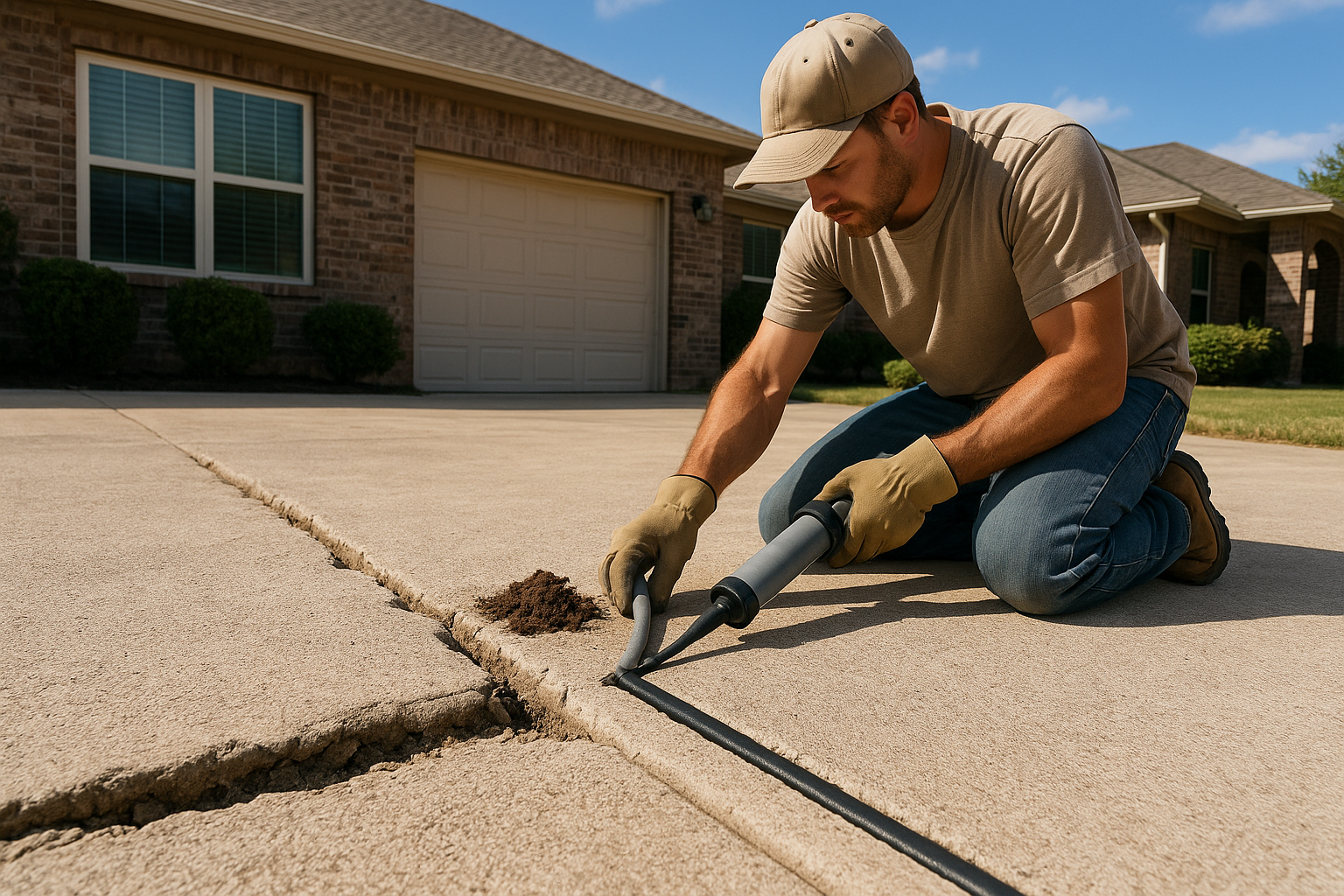
When joints are missing, damaged, or no longer sealed, more water gets below the concrete. That can speed up erosion and subgrade movement. If your joints are cracked or open, take a look at expansion joints and the joint sealing resources at sealmyjoints.com.
The Texas weather pattern does not help. We go from intense summer heat to heavy thunderstorms, then back to dry conditions. That repeated swing is hard on sidewalks, driveways, patios, and foundations alike.
Sidewalk Leveling vs Replacement
A lot of people assume uneven concrete has to be demolished and repoured. Sometimes that is true, but not nearly as often as you might think.
Sidewalk leveling makes sense when the slab is structurally intact and the main issue is settlement. Replacement makes more sense when the concrete is shattered, severely spalled, or moving because of a bigger structural failure.
Here is the practical difference:
- Leveling is usually faster and can often be completed in a few hours
- Leveling is usually lower cost than full tear-out and replacement
- Leveling keeps the existing sidewalk in place, which means less mess and less disruption
- Replacement may require demolition, haul-off, forming, pouring, finishing, and cure time
- New concrete rarely matches old concrete exactly in color or texture
For many Texas homeowners, the cost difference is the deciding factor. While every project is different, leveling is often the better value when the goal is to remove a trip hazard and restore a safe walking surface without paying for full reconstruction. In many cases, homeowners find leveling comes in at a fraction of replacement cost.
Replacement is still the right answer if the slab has major structural cracking, widespread surface failure, or drainage and root issues so severe that the panel cannot be realistically stabilized. But if the concrete is just low, lifting it is usually the smart move.
How Foam Sidewalk Leveling Works
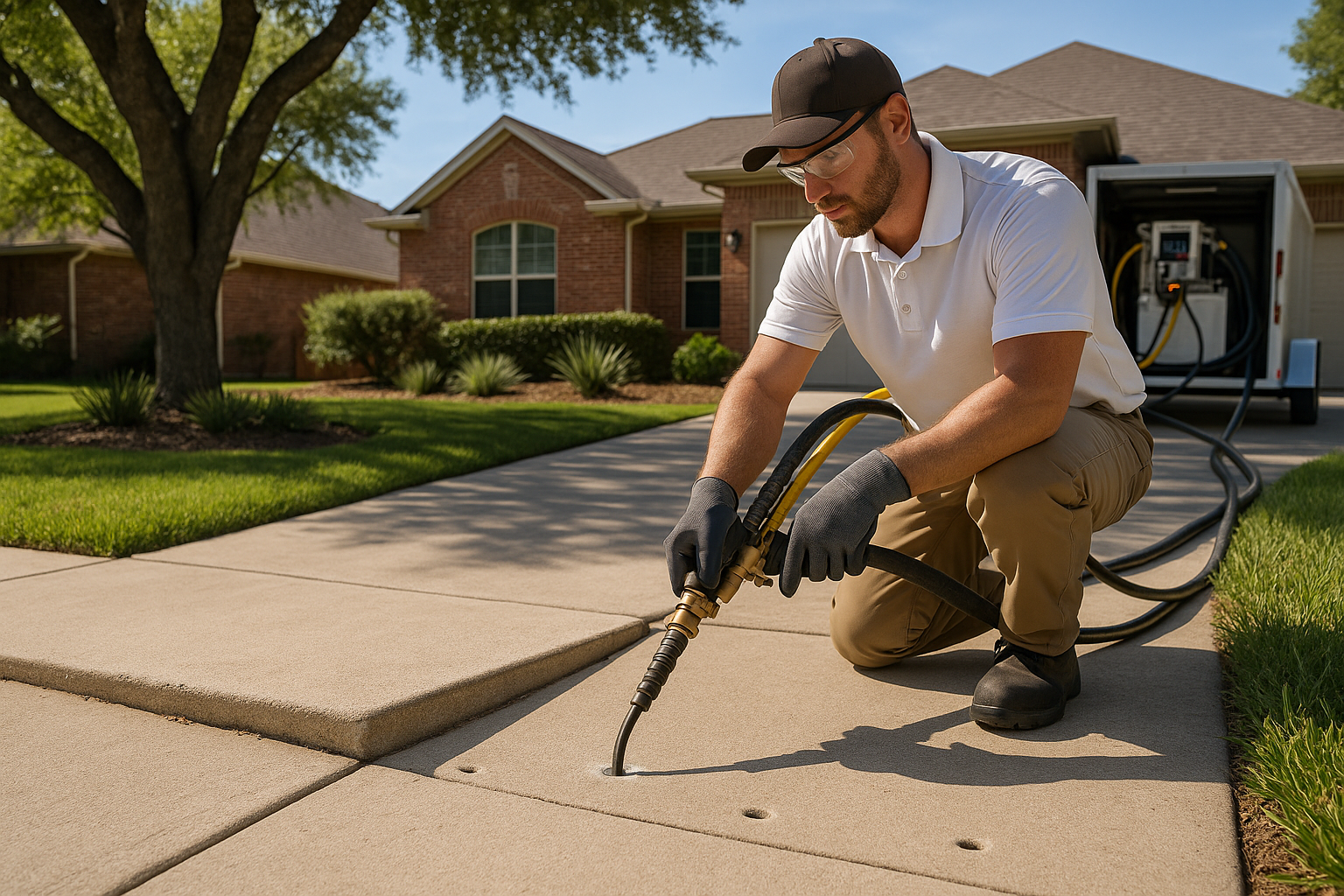
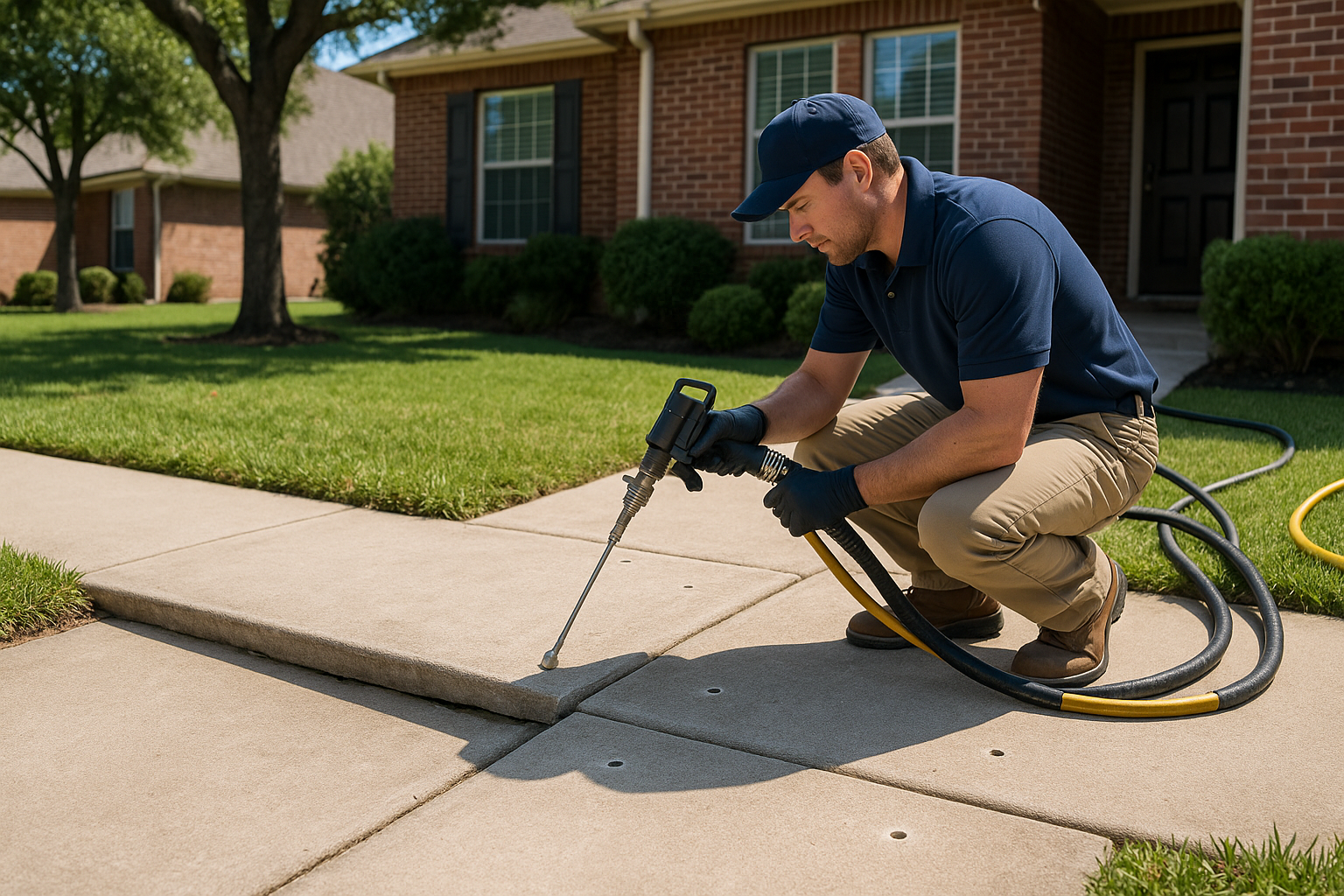
Modern sidewalk leveling is typically done with polyurethane foam injection. This method works well for residential sidewalks because it is precise, clean, and fast.
- We inspect the sidewalk to identify settlement, voids, drainage concerns, and whether the slab is a good candidate for lifting.
- Small holes are drilled through the affected slab sections.
- A two-part polyurethane foam is injected beneath the concrete.
- The foam expands, fills empty space, and gently lifts the slab.
- Once the sidewalk is back to the target elevation, the holes are patched.
This is not a full replacement process. We are working under the slab to restore support and raise it back into alignment. That is why the repair is often much quicker than tearing out and pouring new concrete.
Foam leveling also avoids the long downtime that comes with replacement. In many cases, the sidewalk can be used again much sooner than if a new slab had to be poured and cured.
Another advantage is weight. Polyurethane foam is lightweight compared to older fill methods, so it adds support without overloading already-sensitive soils. That matters in Texas, where unstable subgrades are often the root problem to begin with.
When Foam Leveling Is a Good Fit
- Sunken sidewalk panels with intact concrete
- Trip hazards at panel joints
- Voids under sidewalks caused by washout
- Uneven walkways near porches, patios, or driveways
- Residential paths in neighborhoods with clay soil movement
When It May Not Be the Best Option
- Concrete is broken into multiple loose pieces
- The slab has severe erosion that also needs major drainage correction
- Roots or structural obstacles prevent proper lift
- The walkway was poured too thin or was poorly built from the start
The key is proper evaluation. You do not want someone trying to lift a slab that really needs to be replaced, and you do not want to pay for replacement when leveling would have solved the problem.
In Texas, sidewalk problems are rarely random. Usually there is a reason the slab moved in the first place, whether that is clay shrinkage, drainage, leaking irrigation, runoff concentration, or joint failure. A good repair plan looks at both the surface hazard and the condition below it.
If you have an uneven sidewalk in Austin, Cedar Park, or anywhere nearby, the best next step is to have it checked before the drop gets worse. Catching settlement early can help keep the repair simpler and the cost lower.
Need help with sidewalk leveling in Texas? Contact Hill Country Slabs to get a repair plan that fits the condition of your concrete. Visit /contact or call (737) 287-4308 to schedule an evaluation.