
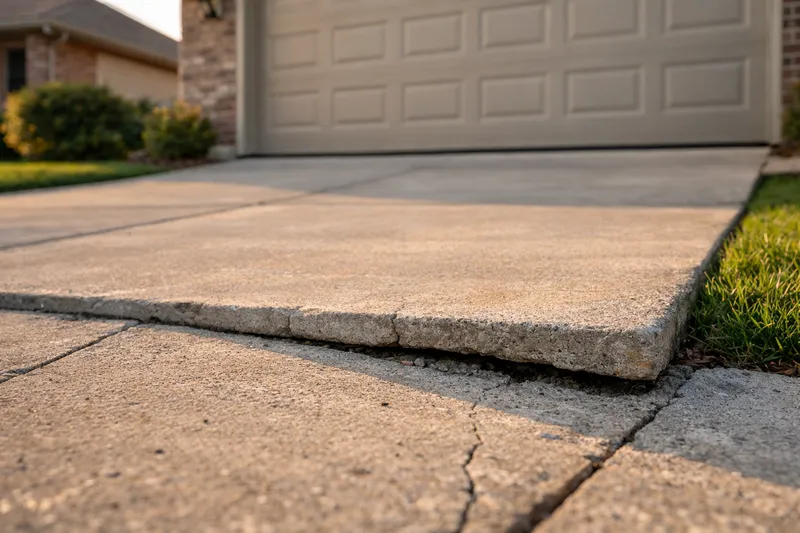
You walk out to your garage one morning and notice it — a gap between the concrete and the garage floor, a slope that wasn't there before, or a crack running across the slab. Your driveway is sinking. It's one of the most common concrete problems in Texas, and understanding why it happens is the first step to fixing it.
The #1 Cause: Expansive Clay Soils
Texas sits on some of the most problematic soils in the country. The Blackland Prairie clay that stretches from Dallas through Austin to San Antonio swells dramatically when it absorbs moisture and shrinks when it dries out. This constant expansion and contraction cycle creates voids beneath your concrete, and gravity does the rest — the slab settles into those voids.
In the Houston area, Gulf Coast clay soils behave similarly, with the added challenge of a high water table that keeps moisture levels unpredictable. The Austin and Dallas-Fort Worth metros face especially aggressive soil movement due to the region's dramatic wet-dry cycles.
Poor Drainage and Water Erosion
Water is concrete's worst enemy — not because it damages the slab directly, but because of what it does to the soil underneath. When gutters dump water next to your driveway, or when the grading around your home directs water toward the slab, the soil beneath erodes over time. This creates voids that cause the concrete to sink unevenly.
One often-overlooked source of water infiltration is unsealed expansion joints. If your driveway's expansion joints still have the original plywood filler, they act as channels that funnel rainwater directly under the slab. Sealing your expansion joints with silicone is one of the most effective preventative steps you can take — learn more at SealMyJoints.com.
Signs of drainage-related settling include:
- Sinking concentrated on one side of the driveway
- Settling near downspouts or low spots in the yard
- Visible erosion channels near the slab edges
Tree Roots and Organic Decomposition
Large trees near your driveway can cause problems in two ways. While alive, their roots can push up sections of concrete. After removal, the decomposing root system leaves voids beneath the slab. Either way, the result is uneven concrete that gets worse over time.
Poor Compaction During Construction
When your home was built, the soil beneath the driveway should have been compacted in layers before the concrete was poured. If the builder rushed this process — which happens more often than you'd think during Texas building booms — the soil settles over the first few years, taking the concrete with it.
This is especially common in fast-growing areas like Frisco, Kyle, Forney, and Fulshear, where rapid construction sometimes outpaces quality control.
How to Fix a Sinking Driveway
The good news: you almost certainly don't need to tear out and replace your driveway. Polyurethane foam leveling (also called foam jacking) injects high-density foam beneath the settled slab through small, penny-sized holes. The foam expands to fill voids, lifts the concrete back to grade, and hardens in about 15 minutes.
Compared to full replacement, foam leveling typically costs 50-70% less, takes a few hours instead of days, and your driveway is ready to drive on the same day. The closed-cell foam also won't erode or wash away like the soil that caused the problem in the first place.
When to Act
Don't wait for a sinking driveway to become a safety hazard. Trip hazards, water pooling, and continued settling only get worse with time. If you notice a gap at the garage, uneven sections, or new cracks, it's time to get a professional assessment.
Hill Country Slabs offers free concrete inspections and estimates throughout Texas. Request a free quote or call us at (737) 287-4308.