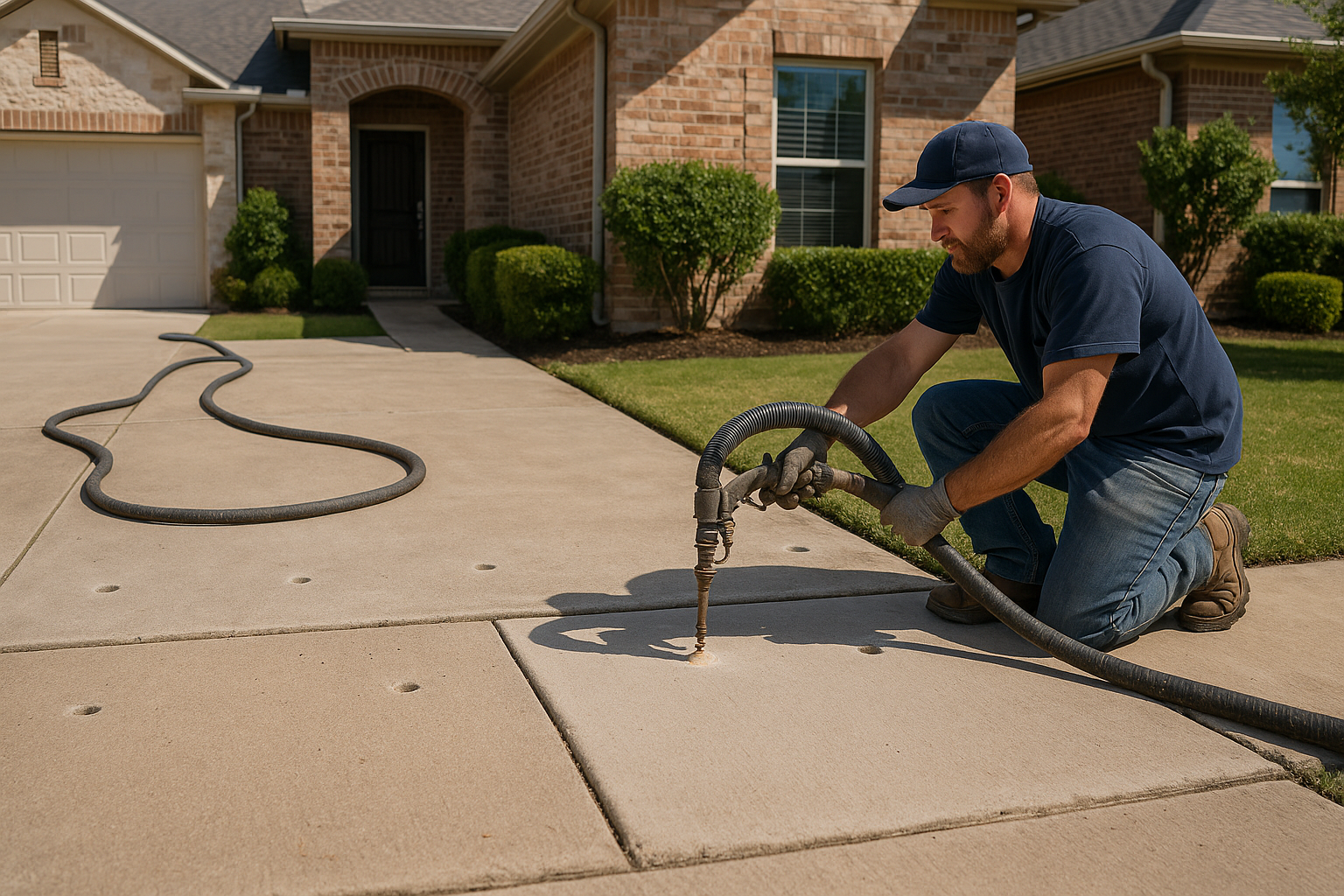
If you are looking up concrete leveling before and after cost in Texas, you are probably dealing with a slab that has dropped, cracked at a joint, or turned into a trip hazard. We see it every week on driveways, sidewalks, pool decks, patios, garage floors, and porch slabs from Austin, TX to Houston, TX. The good news is a lot of these slabs do not need to be torn out and replaced. In many cases, they can be lifted, stabilized, and put back into service fast.
At Hill Country Slabs, we like showing customers the before and after because that is where the value really shows up. A slab that was dipping toward the house, holding water, or creating a nasty lip at the joint can often be brought back into line in a matter of hours. And in Texas, where movement is tied to expansive clay, drought, hard rain, and poor drainage, leveling is often the practical fix.
If you want to learn more about the process itself, take a look at Concrete Lifting in Texas and Polyurethane Concrete Leveling in Texas. If your slabs are moving at the joints, it is also smart to understand why joint protection matters at /expansionjoints and sealmyjoints.com.
What Concrete Leveling Before and After Looks Like
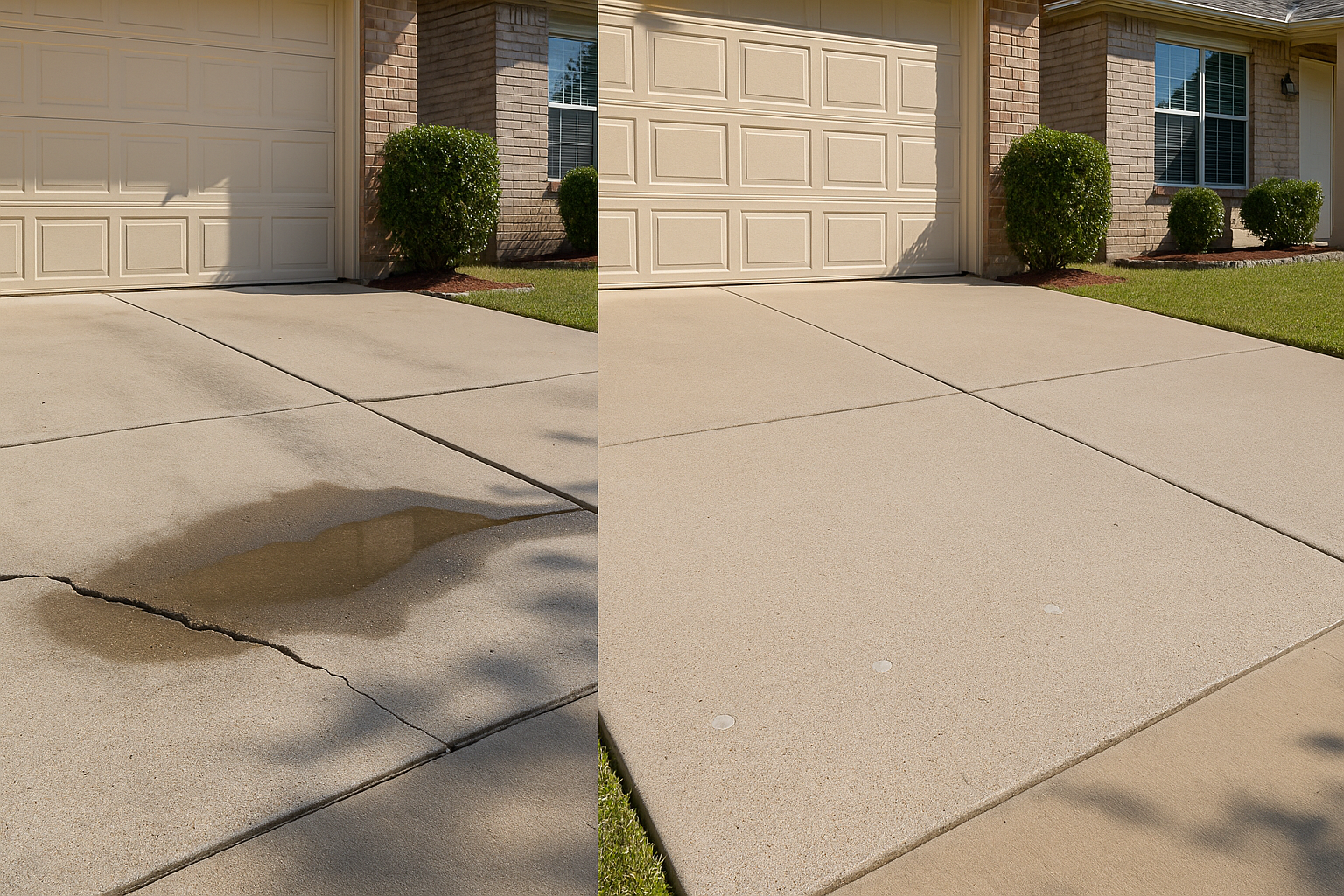
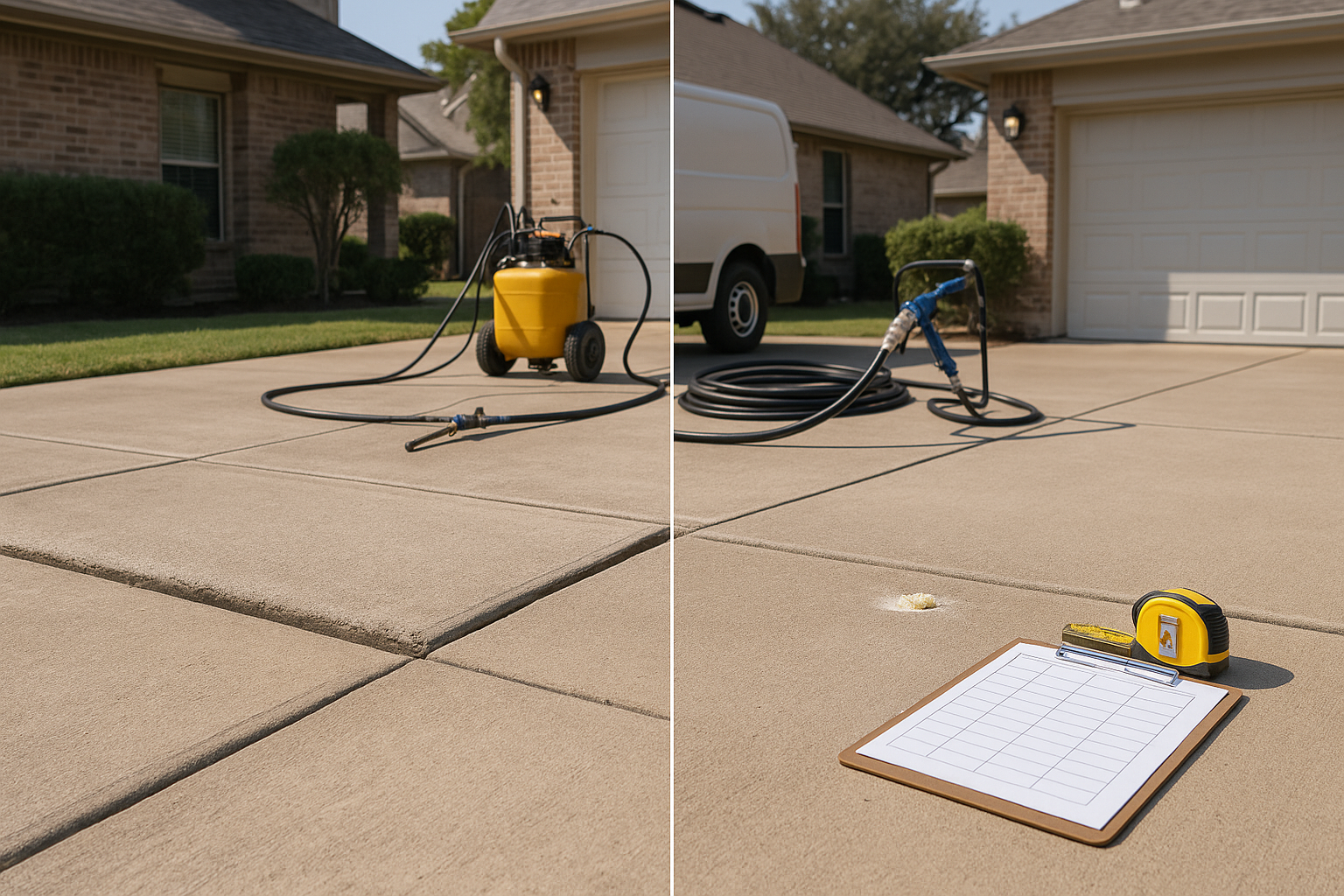
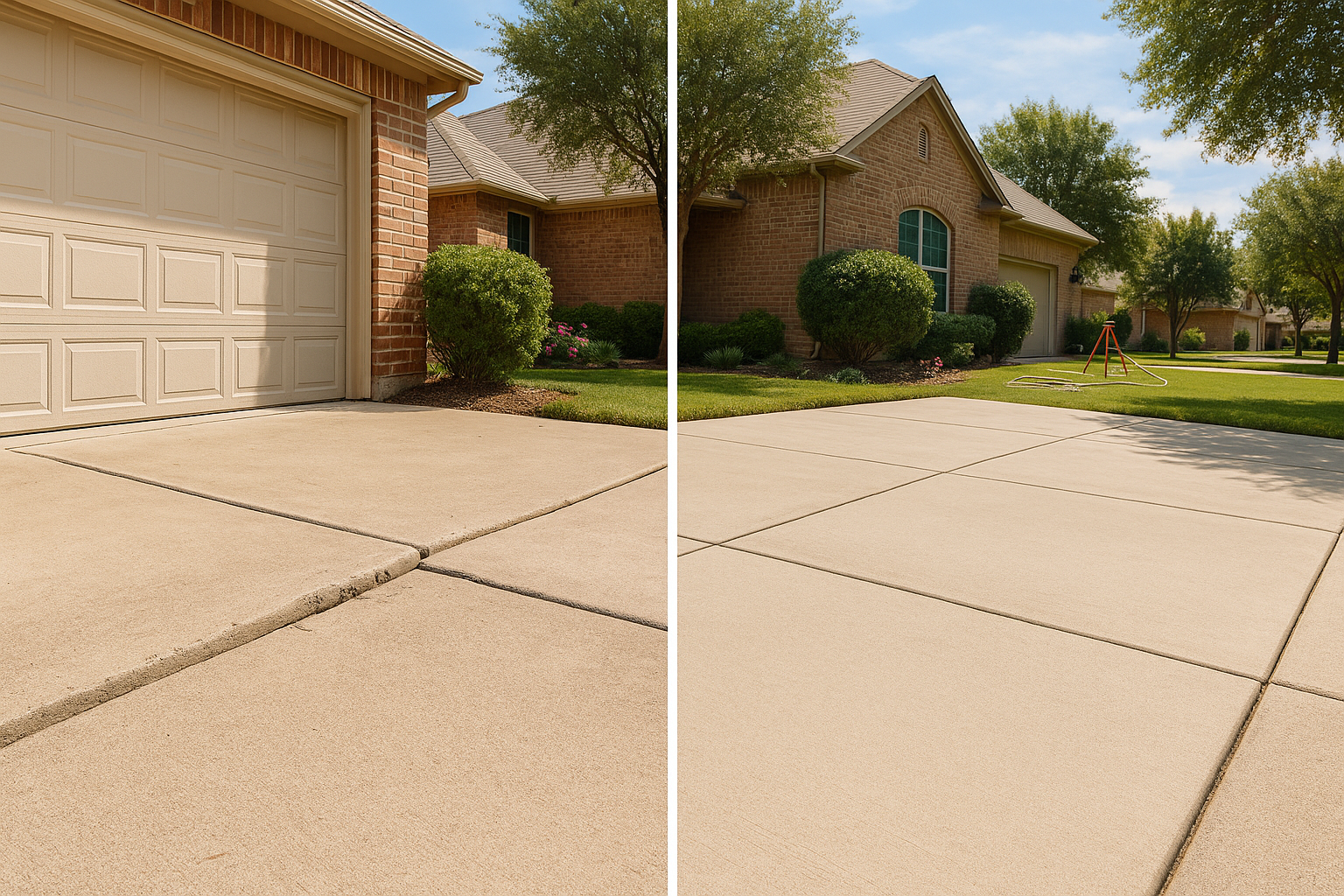
Before leveling, the usual signs are pretty easy to spot. One slab panel sits lower than the one next to it. Water ponds after a rain. A driveway edge near the garage drops enough to feel it when you pull in. Sidewalk sections tilt and create a trip hazard. Patio slabs pull away from the house or settle around columns and steps.
After leveling, the change is not just cosmetic. The slab sits closer to its original elevation, the transition between panels is smoother, drainage improves, and the surface is safer to walk and drive on. In the best cases, customers keep the concrete they already have, avoid a demolition mess, and get a repair that is done the same day.
Here is what before and after usually means in the field:
- Driveways: a dropped panel at the garage or apron gets lifted to reduce the bump and help water move away from the structure.
- Sidewalks: uneven sections are raised to remove trip hazards and improve curb appeal.
- Patios: settled slabs near the back door are brought up to reduce standing water and create a flatter outdoor surface.
- Pool decks: sunken areas around coping or deck joints are corrected with care to improve safety.
- Porches and steps: supported slabs can often be lifted without the cost of full replacement.
Texas soils have a lot to do with these before and after results. In Central Texas, we deal with expansive clay that shrinks in dry weather and swells when moisture comes back. In Houston and the Gulf Coast, saturated soils and drainage issues can soften support below the slab. In North Texas, long hot summers followed by heavy storms can create repeated movement cycles. The slab sinks because the support under it changes. Leveling works by filling voids, adding support, and carefully lifting the concrete back up.
How Much Concrete Leveling Costs in Texas
For most residential projects in Texas, concrete leveling cost depends on the size of the slab, how far it has settled, access for equipment, and how much material it takes to stabilize and lift it. As a ballpark, homeowners often see costs like these:
- Small sidewalk or walkway sections: $600 to $1,200
- Single patio or porch slab: $800 to $1,800
- Driveway panel leveling: $1,000 to $2,500
- Larger multi-panel driveway or patio projects: $2,500 to $5,000+
Those are general Texas ranges, not quote numbers. A short sidewalk with one settled panel in Austin may come in near the lower end. A driveway in Houston with several dropped sections, washed-out base, and drainage trouble can run higher. The big takeaway is this: leveling is usually much less expensive than full replacement.
Replacement means demolition, haul-off, base work, forming, new concrete, finishing, curing time, and sometimes matching issues with the remaining slab. In many cases, leveling can save homeowners 30% to 70% compared to replacement, especially when the existing concrete is still structurally decent.
There is also the time factor. A foam leveling job is often completed in hours, not days. Most slabs can be used again quickly once the work is done. That matters for busy driveways, front walks, and commercial entries where downtime costs money too.
Real-world before and after cost scenarios
- Front walkway in Austin: two sidewalk panels have settled and created a lip near the porch. If the concrete is in good shape and access is easy, the repair may land around $700 to $1,100.
- Driveway near garage in Houston: one or two sections have dropped, water is standing near the foundation, and the soil stays wet after storms. A typical repair might run $1,200 to $2,200, depending on lift needed and void size.
- Back patio in Central Texas: a slab has settled away from the house and now holds water along the edge. A leveling and stabilization repair may fall around $900 to $1,800.
- Multi-panel driveway with widespread settlement: if several panels are involved, some cracking is present, and extra stabilization is needed, cost can move into the $2,500 to $5,000+ range.
What Changes the Price of Foam Leveling
Polyurethane foam leveling is a strong option for Texas slabs because it is lightweight, precise, and cures quickly. But pricing is never one-size-fits-all. Here is what usually changes the number.
Amount of settlement
A slab that dropped half an inch is a different repair than one that fell two inches or more. More settlement usually means more injected material, more time dialing in the lift, and more attention to stabilization underneath.
Size and thickness of the slab
Bigger panels take more work. Thicker concrete can also affect the approach. Driveway slabs, garage approaches, and heavy-use areas generally need a little more planning than a standard walkway panel.
Voids under the concrete
Sometimes the visible drop is only part of the issue. If water has washed out the base or the soil has pulled away due to drought shrinkage, there may be larger hidden voids. Filling those voids is part of doing the job right.
Access to the work area
A front sidewalk with open access is simpler than a tight backyard patio, gated side yard, or pool deck with limited equipment room. The harder it is to reach the slab, the more labor can be involved.
Condition of the concrete
Leveling works best when the slab is still worth saving. If the concrete is badly broken, shattered at corners, or deteriorated from the inside out, replacement may be the smarter call. Leveling lifts concrete. It does not turn failed concrete into brand-new material.
Drainage and joint issues
One reason slabs settle again is that the water problem never got fixed. Poor runoff, downspout discharge, missing sealant, and open joints all let water work its way below the slab. That is why we tell property owners to pay attention to joint sealing and movement control. Learn more at /expansionjoints and sealmyjoints.com. Protecting the joints helps protect the repair.
When Leveling Makes More Sense Than Replacement
In Texas, replacement is not always the best first move. If the slab is mostly intact and the main problem is settlement, leveling often makes more sense. You keep the existing concrete, avoid tearing up surrounding areas, and get the slab back where it belongs faster.
Leveling usually makes sense when:
- The slab is sunken but still in one piece or has only minor cracking.
- The problem is isolated to one area, like a driveway joint, sidewalk panel, or patio corner.
- You want a faster repair with less disruption.
- You want to correct drainage and trip hazards without full demolition.
- You are trying to control repair costs while extending the life of the slab.
Replacement usually makes more sense when:
- The concrete is badly broken into multiple loose sections.
- The slab has severe surface deterioration or major structural failure.
- The area was poured wrong to begin with and needs full redesign.
- There are underlying issues that require reconstruction, not just lifting.
For a lot of homeowners in places like Austin, San Antonio, Round Rock, Georgetown, Houston, and surrounding Texas communities, the smart path is to have the slab evaluated before assuming replacement is the only answer. We have seen many jobs where a customer expected a full tear-out and ended up with a clean lift and stabilization repair instead.
The before and after on these projects is hard to ignore. The slab looks better, performs better, drains better, and costs a lot less than starting from scratch in many cases. That is why foam leveling has become a go-to repair for settled residential concrete across Texas.
If you are dealing with a sunken driveway, uneven sidewalk, settled patio, or slab pulling away at the joints, Hill Country Slabs can take a look and tell you whether leveling is the right fix. Contact us at /contact or call (737) 287-4308 to schedule an estimate.