
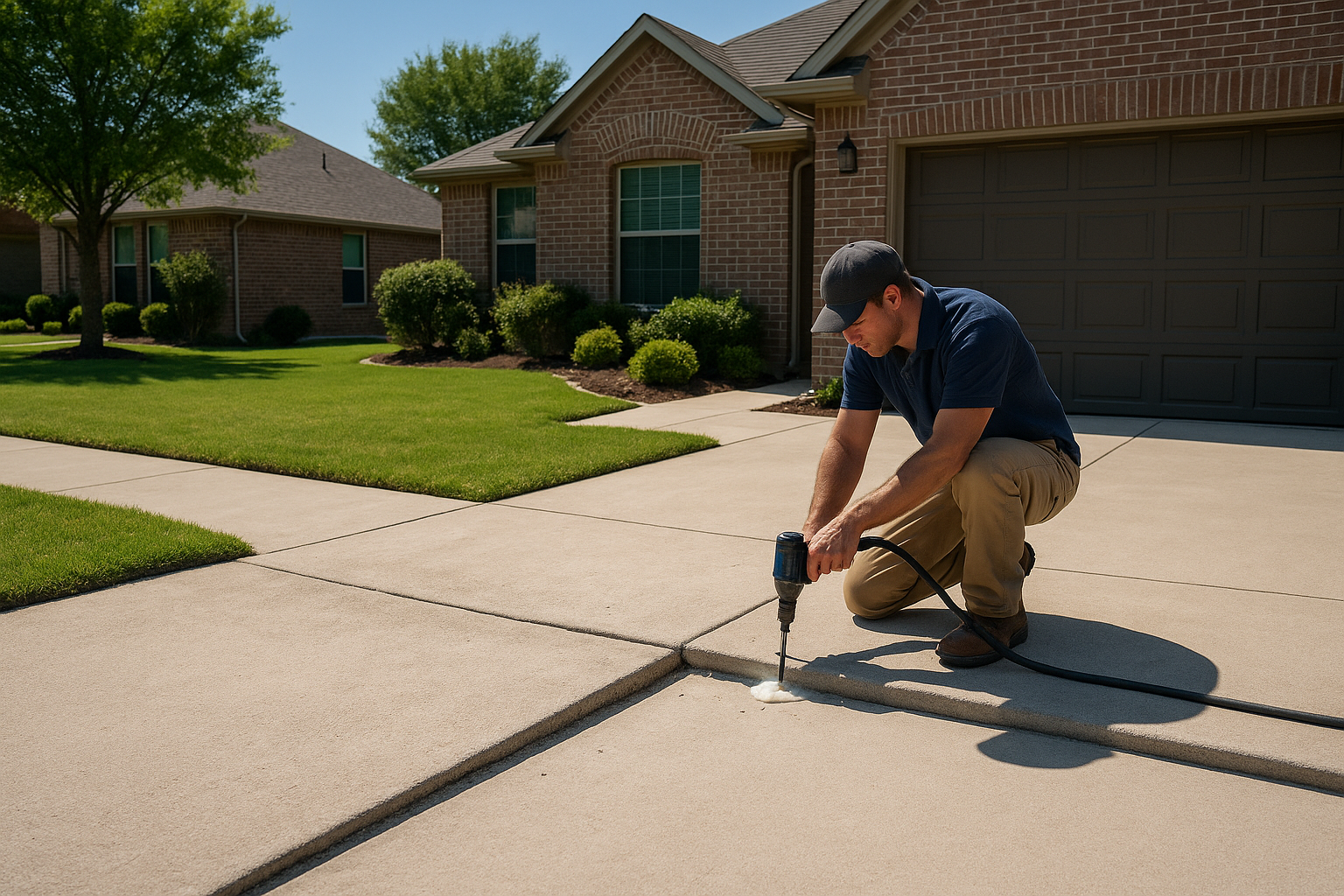
If you need concrete leveling in Dallas, TX, you are probably looking at a driveway, sidewalk, patio, or garage slab that has dropped, tilted, or started holding water. Around North Texas, that is common. Between long dry spells, heavy rain, and the clay soil Dallas is known for, concrete moves. The good news is you usually do not have to tear it out and start over. In a lot of cases, foam lifting can raise the slab back into place faster and for a lot less money than replacement.
At Hill Country Slabs, we talk to homeowners all over Texas dealing with settled concrete. In Dallas, the problem usually comes back to expanding and shrinking soils, poor drainage, and washout under the slab. If the concrete is still in decent shape, leveling is often the smart fix. It is clean, quick, and you can usually use the slab again the same day.
Why Concrete Sinks in Dallas, TX
Dallas sits on some of the most movement-prone soils in Texas. A lot of neighborhoods in North Texas have highly expansive clay. When that clay gets wet, it swells. When it dries out in the summer heat, it shrinks and pulls away. That constant cycle leaves voids under concrete. Once the support underneath is gone, the slab starts to settle.
We also see sinking caused by drainage problems. Downspouts dumping next to a driveway, sprinkler overspray, poor grading, and water running under sidewalks can all erode the base. In Dallas, Plano, Richardson, Garland, Irving, and surrounding areas, storm cycles can hit hard and fast. One week the soil is baked dry, the next week you get a heavy rain. That swing is rough on flatwork.
Tree roots can play a part too, but not always the way people think. Sometimes roots lift one section while nearby dry soil causes another section to drop. The result is uneven concrete, trip hazards, and cracks that keep getting worse if nobody addresses the cause.
If you have a sunken driveway or walk, leveling makes a lot of sense when the slab is structurally sound. Our Driveway Leveling service is designed for exactly that kind of repair. For pedestrian areas with trip hazards, our Sidewalk Repair solutions can restore the surface without replacing every panel.
Signs You Need Concrete Leveling
Not every crack means you need a full replacement. A lot of Dallas homeowners wait too long because they assume uneven concrete has to be torn out. Here are the most common signs it is time to level the slab:
- One edge of the slab has dropped and created a step-up or trip hazard.
- Water is ponding on the driveway, patio, or sidewalk after rain.
- Cracks are forming near corners or control joints because the slab lost support underneath.
- Your garage apron or driveway is sloping back toward the house instead of draining away.
- Patio slabs are pulling away from the home or settling unevenly.
- Sidewalk panels are out of alignment and becoming a safety issue.
In many cases, homeowners call us when they are getting ready to sell or when a family member trips on the walk. But it is better to handle it earlier. A small settlement issue is usually cheaper to correct than waiting until the slab cracks apart or drainage starts affecting the foundation.
As a rough rule, leveling is often the right move when the slab is intact and just unsupported underneath. Full replacement is usually needed when the concrete is badly broken, heaved beyond repair, or too thin to salvage. For many Dallas-area projects, foam lifting comes in at roughly 50% to 70% less than full replacement, depending on access, slab condition, and how much lift is needed. It is also a lot faster, with many jobs completed in a few hours instead of several days.
How Foam Concrete Lifting Works
Foam concrete lifting, sometimes called polyurethane concrete leveling, is a straightforward process. We drill small holes through the settled slab and inject a high-density expanding foam underneath. As that foam expands, it fills empty space, compacts weak areas, and lifts the concrete in a controlled way. Once the slab is back where it belongs, the holes are patched and the surface is ready for use shortly after.
That method works well in Dallas because it does not add a bunch of extra weight to already unstable soil. Traditional mudjacking uses a heavier slurry. Foam is lighter, cleaner, and easier to control when we are trying to make fine adjustments on a driveway, walkway, pool deck, or patio.
Here is how a typical leveling job goes:
- We inspect the slab, measure the settlement, and look for the cause of the problem.
- We identify voids, weak spots, drainage issues, and any signs the concrete is too damaged to lift.
- We drill small injection holes in the affected slab sections.
- We inject polyurethane foam in stages to fill voids and raise the concrete evenly.
- We check the final elevation, patch the holes, and confirm drainage is improved.
One thing we always tell Dallas homeowners is this: lifting the slab is only part of the repair. If water keeps washing out the base or if joints stay open and let moisture down below, the problem can come back. That is why expansion joints matter. If your joints are cracked, missing sealant, or pulling apart, take a look at our expansion joints information. Proper joint sealing helps keep water out of the subgrade. For more on sealing and long-term joint protection, visit sealmyjoints.com.
Foam leveling is commonly used on driveways, sidewalks, porches, patios, garage floors, and some interior slabs. In Texas, it is especially useful where you want to preserve existing concrete and avoid the mess of demolition. Homeowners in Dallas are often surprised that the repair can be done with minimal disruption and without leaving a torn-up yard or a dumpster in the driveway.
Dallas Weather and Soil Make Timing Important
North Texas weather does not do concrete any favors. Summer heat can dry clay soils out fast. Then fall and spring storms load that same soil back up with moisture. Those moisture swings are a big reason concrete settles unevenly in this region. If you have noticed new movement after a drought or after a wet stretch, that is not unusual.
It is smart to fix settled slabs before the elevation problem starts affecting drainage patterns around the home. Water that runs the wrong direction can create larger issues over time. We see that concern not just in Dallas but in other major Texas markets too, including Austin and Houston, where different soil and rain patterns still lead to the same basic result: unsupported concrete.
What Foam Leveling Will Not Fix
Foam lifting is a strong repair option, but it is not magic. If a slab is shattered, severely heaved, or poured on a failed base with major structural issues, replacement may be the better answer. The same goes for concrete that is too thin, badly spalled, or already patched over and over. A good contractor will tell you when leveling makes sense and when it does not.
That is why an honest site evaluation matters. The goal is not to sell a shortcut. The goal is to fix the concrete the right way based on the slab condition, the soil behavior, and the drainage around it.
Get a Free Quote for Dallas Concrete Leveling
If your driveway, sidewalk, patio, or slab is sinking, do not wait until somebody trips or the crack spreads across the whole panel. In Dallas, settled concrete usually gets worse with time because the soil underneath keeps moving. Catching it early can save you money and help you avoid full replacement.
Hill Country Slabs provides straightforward guidance on concrete leveling and slab repair options for Texas property owners. If your concrete is a good candidate for lifting, foam leveling can often restore it quickly, improve drainage, and extend the life of the slab at a much lower cost than replacement.
Ready to talk about your project? Contact us at /contact or call (737) 287-4308 for a free quote on concrete leveling in Dallas, TX.